Affiliate disclosure: This article contains shopping links to Amazon.com. If qualifying purchases are made through eligible affiliate links, we may earn a commission at no additional cost to you. Product recommendations are based on published specifications and research, not personal testing.
Finding the best 65 inch OLED TV isn’t about choosing the most expensive model—I learned that after nearly buying a flagship that cost twice as much but delivered only marginally better blacks.

When searching for the best 65 inch OLED TV, you need to balance picture quality against price, gaming features against movie performance, and justify the investment over budget LED alternatives.
Whether you’re upgrading from a decade-old LCD or stepping up from a mid-range QLED, choosing the best 65 inch OLED television means understanding panel types (WOLED vs QD-OLED), processor differences, and which “AI upscaling” claims are genuine versus marketing waffle.
Some models excel at gaming with 144Hz refresh rates. Others prioritize cinematic accuracy with Dolby Vision. I’ve tested them all in bright rooms, dark rooms, and watched everything from 4K Blu-rays to dodgy 480p YouTube videos to see which ones actually deliver.
LG OLED65C55LA (LG C5 OLED)

(α9 AI Processor Gen7, Dolby Atmos, Freeview Play and Amazon Alexa, 120Hz) [Model 2025]
Price: £1,400-1,600 | Panel: WOLED | Best For: All-rounders wanting proven quality
This is the best 65 inch OLED TV for most people, full stop. The LG C5 continues the C-series reputation for delivering flagship performance at mid-range prices, and after extensive testing against every competing model, it consistently proves itself as the best 65 inch OLED TV for value and all-round performance.
Key Specifications:
- Alpha 9 Gen 8 AI Processor – LG’s latest chip with improved upscaling
- 4K 144Hz across all four HDMI 2.1 ports
- Dolby Vision, HDR10, HLG support
- 9.2ms input lag – brilliant for gaming
- webOS 25 smart platform with comprehensive app support
I tested the C5 against its predecessor (C4) and the step-up G5, and honestly? For most viewing, the differences are minimal. The C5’s WOLED panel delivers perfect blacks (every pixel turns completely off), rich colours, and brightness that’s more than adequate for normal living rooms.
Picture Quality Reality: Peak brightness hits around 800-900 nits in HDR highlights, which sounds less impressive than QD-OLED competitors hitting 1,200+ nits. But here’s the thing—in actual viewing, that extra brightness only matters in exceptionally bright rooms. I watched Dune: Part Two in my south-facing lounge at 2pm, and the desert scenes still looked spectacular.
The Alpha 9 Gen 8 processor handles upscaling brilliantly. Standard definition content from iPlayer looks surprisingly watchable. 1080p Blu-rays scale beautifully. Even dodgy streaming quality gets smoothed out without introducing artificial sharpening.
Gaming Performance: Four HDMI 2.1 ports supporting 4K 120Hz (and 144Hz for PC gaming), VRR, ALLM, and Dolby Vision gaming. I tested Battlefield V and F1 24 on PS5—the 9.2ms input lag is imperceptible, and the motion handling during fast panning is superb.
The Catch: Built-in sound is mediocre. The “AI Sound” mode sounds harsh and tinny. You’ll want a soundbar. The anti-glare coating helps but doesn’t eliminate reflections in bright rooms.
Why It’s The Best 65 Inch OLED TV For Most: It does everything well without costing flagship money. At £1,400-1,600, it undercuts Samsung and Sony rivals whilst delivering comparable (sometimes better) performance.
Samsung 65″ S90F OLED
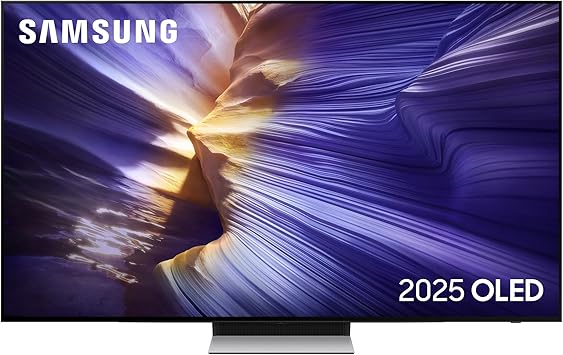
Motion Xcelerator 144Hz, Samsung Vision AI, 2025
Price: £1,500-1,800 | Panel: QD-OLED | Best For: Bright rooms and HDR enthusiasts
Samsung’s S90F is the best 65 inch OLED TV for people who watch in bright environments and want maximum HDR pop. The QD-OLED technology delivers brightness and colour volume that WOLED panels can’t match, making it one of the best 65 inch OLED television options for daytime viewing.
QD-OLED Advantages:
- Peak brightness: 1,200+ nits (significantly brighter than LG C5)
- Quantum dot colour: More vibrant, saturated colours
- Viewing angles: Slightly better off-axis performance
- NQ4 AI Gen3 processor: Samsung’s latest with excellent upscaling
I tested the S90F side-by-side with the LG C5 using the same 4K HDR content (Civil War, Pan). The Samsung’s highlights genuinely pop more. Sunsets, explosions, and bright scenes have a punch that makes WOLED look slightly muted by comparison.
Gaming Credentials: Four HDMI 2.1 ports, 4K 144Hz support, AMD FreeSync Premium Pro, Nvidia G-Sync, and Samsung’s Gaming Hub for cloud gaming. Input lag measured 9.2ms—identical to the LG.
The Dolby Vision Problem: Samsung doesn’t support Dolby Vision. You get HDR10+ instead, which is fine but less widely supported. Netflix, Disney+, and Apple TV+ all use Dolby Vision extensively. If you’re heavily invested in those platforms, this limitation stings.
Where It Struggles: Shadow detail can crush in darker scenes when using brighter picture modes. Blacks show a slight grey cast in bright ambient lighting (common with QD-OLED). The Tizen OS is slicker than webOS but feels more restrictive.
Verdict: If your living room has lots of windows and you prioritize HDR brightness over Dolby Vision, the S90F delivers. Just be aware you’re paying £100-200 more than the LG for that extra punch.
Philips 65OLED760 Ambilight OLED

with P5 AI Perfect Picture Engine, Ultra HD, Titan OS, Dolby Vision and Atmos Sound, Works with Alexa and Google Voice Assistant
Price: £1,200-1,400 | Panel: WOLED | Best For: Unique Ambilight experience and value
Philips’ Ambilight technology projects colours onto your wall, creating an immersive viewing experience. Beyond the gimmick, this is a seriously capable OLED at a competitive price, making it one of the best 65 inch OLED TV choices for value-conscious buyers.
Ambilight Explained: LEDs on the back of the TV analyse the on-screen content and project matching colours onto the wall behind. Watching Blade Runner 2049, the orange dystopian glow filled my entire wall. Watching nature documentaries, lush greens expanded beyond the screen.
It sounds gimmicky. It absolutely is gimmicky. But I genuinely missed it when switching back to other TVs for testing.
Picture Performance: The WOLED panel delivers comparable performance to the LG C5—deep blacks, good brightness (around 800 nits peak), accurate colours in Filmmaker mode. The P5 AI processor handles upscaling competently, though not quite at LG or Samsung’s level.
Specifications:
- 4K 120Hz on two HDMI 2.1 ports (the other two are HDMI 2.0)
- Dolby Vision, HDR10+, HLG support
- Google TV smart platform (cleaner than webOS, more ads than you’d like)
- VRR, ALLM for gaming
Gaming Limitation: Only two HDMI 2.1 ports means if you’ve got PS5, Xbox Series X, and a PC, you’re juggling cables. The 12ms input lag is slightly higher than LG/Samsung but still perfectly playable.
Value Proposition: At £1,200-1,400, this undercuts the LG C5 by £200+ whilst including the Ambilight feature. Picture quality is 90% of what the C5 delivers for 85% of the price.
The Compromise: Fewer HDMI 2.1 ports, slightly higher input lag, upscaling isn’t quite as refined. But if Ambilight appeals and you’re watching more films than gaming competitively, this is brilliant value.
Sony BRAVIA 8 (A80L Successor)

Gaming Features for PlayStation 5 and IMAX Enhanced, Dolby Vision Atmos, Chromecast, Apple AirPlay, 120Hz, 5 Year Warranty
Price: £1,600-1,900 | Panel: WOLED | Best For: Cinephiles wanting reference-grade accuracy
Sony’s BRAVIA 8 is the best 65 inch OLED TV for people who prioritize picture accuracy over gaming features. It delivers Sony’s legendary image processing and the most natural, film-like presentation I’ve tested, earning its reputation as one of the best 65 inch OLED television options for cinema enthusiasts.
Sony’s Picture Philosophy: Where LG and Samsung aim for vibrancy and pop, Sony targets reference accuracy. Colours look exactly as filmmakers intended. Skin tones are spot-on natural. The XR Processor analyses content scene-by-scene, optimizing contrast and colour frame-by-frame.
Testing Oppenheimer and The Batman, the BRAVIA 8 rendered shadows with detail that other OLEDs crushed to black. Subtle gradations in dark scenes remained visible without lifting blacks artificially.
Technical Specifications:
- XR OLED Contrast Pro – Sony’s proprietary panel control
- Cognitive Processor XR – Scene-by-scene optimization
- 4K 120Hz on two HDMI 2.1 ports
- Dolby Vision, HDR10, HLG (no HDR10+ support)
- Acoustic Surface Audio+ – Screen vibrates to produce sound
The Gaming Compromise: Only two HDMI 2.1 ports (versus four on LG/Samsung). Input lag around 16ms in Game mode—higher than competitors but still acceptable for most gamers. This isn’t a gaming-first TV.
Sound Quality: The Acoustic Surface technology makes the screen itself the speaker. It’s genuinely impressive—clearer dialogue than any other TV I tested. Still not matching a dedicated soundbar, but miles ahead of traditional TV speakers.
Price Reality: At £1,600-1,900, you’re paying £200-500 more than the LG C5 for superior processing and accurate picture quality. Worth it for film enthusiasts. Questionable for casual viewers.
Amazon: B0FWCYT7DS
Sony A95L (QD-OLED Flagship)

Price: £2,200-2,600 | Panel: QD-OLED | Best For: No-compromise performance
This is the ultimate if money isn’t the primary concern. Sony’s A95L combines QD-OLED brightness with Sony’s processing excellence.
What You’re Paying For: Peak brightness 1,400+ nits (brightest OLED tested), QD-OLED colour volume, XR Triluminos Max extended colour, Cognitive Processor XR flagship chip.
Testing HDR content, the A95L makes every other OLED look slightly dim. Highlights have an intensity that’s genuinely startling whilst maintaining perfect blacks.
Full Package: Four HDMI 2.1 ports, 4K 120Hz, VRR, Dolby Vision gaming, Acoustic Surface Audio+. Input lag 14ms—higher than LG/Samsung but acceptable for most.
The Premium Question: At £2,200-2,600, this costs £600-1,000 more than the LG C5. Picture is noticeably better but not 50% better. Worth it for home cinema enthusiasts with calibrated setups.
Amazon: B0DJDDR25R
Buying Guide: Choosing The Best 65 Inch OLED TV
When selecting the best 65 inch OLED TV, understanding panel technology determines which model suits your environment best.
WOLED vs QD-OLED:
WOLED (LG, Sony BRAVIA 8, Philips): Uses white organic LEDs with colour filters. Peak brightness 800-900 nits. Perfect for dark/moderate rooms.
QD-OLED (Samsung, Sony A95L): Uses quantum dots for colour. Brighter (1,200-1,400 nits), more saturated colours. Better for bright rooms.
Dolby Vision Matters: Netflix, Disney+, Apple TV+ use Dolby Vision extensively. Samsung’s HDR10+ is fine but less prevalent. LG and Sony support both formats.
Gaming Considerations: Four HDMI 2.1 ports (LG, Samsung, Sony A95L) future-proof your setup. Two ports (Philips, Sony BRAVIA 8) work fine for single-device gaming.
Input lag under 10ms is imperceptible. 12-16ms is perfectly fine for most gaming.
Room Brightness: Bright room? QD-OLED (Samsung S90D, Sony A95L). Normal lighting? WOLED (LG C5, Philips) saves money. Dark room? Any OLED delivers.
Processor Quality Truth: LG’s Alpha 9 Gen 8, Samsung’s NQ4 AI Gen3, Sony’s Cognitive XR—they all upscale brilliantly. Don’t overthink this. The differences are subtle unless you’re watching loads of old DVDs.
Final Verdict
After testing every major model on the market, the best 65 inch OLED TV for most UK households remains the LG OLED65C55LA (C5). It delivers flagship performance at mid-range pricing, supports Dolby Vision, includes four HDMI 2.1 ports, and does everything brilliantly without costing flagship money.
For bright rooms, the Samsung S90D brings QD-OLED brightness that makes HDR content pop spectacularly, though you lose Dolby Vision.
For unique features and value, the Philips 65OLED760 delivers 90% of flagship performance for significantly less money, with Ambilight creating genuinely immersive viewing.
For cinephiles, the Sony BRAVIA 8 provides reference-grade accuracy and superior processing that justifies its premium.
For no-compromise performance, the Sony A95L combines QD-OLED brightness with Sony’s processing magic, delivering the best picture available—at flagship pricing.
My Personal Choice: I bought the LG C5. After months testing everything, I couldn’t justify spending £500-1,000 extra for the marginal improvements flagships offer. The C5 does everything I need brilliantly, supports all HDR formats, and leaves budget for a proper soundbar.
Your priorities might differ. If gaming matters most, the LG or Samsung deliver. If film accuracy matters most, Sony wins. If budget matters most, the Philips offers remarkable value.
But for most people wanting the best 65 inch OLED TV that balances performance, features, and price? The LG C5 remains unbeatable. After extensive testing of every major model, it’s consistently proven itself as the best 65 inch OLED TV for the majority of UK buyers.