Affiliate disclosure: This article contains shopping links to Amazon.com. If qualifying purchases are made through eligible affiliate links, we may earn a commission at no additional cost to you. Product recommendations are based on published specifications and research, not personal testing.

Stop Buying the Wrong Projector
Here’s the honest truth that most projector marketing glosses over: the majority of buyers waste money because they pick a projector for its headline spec rather than how it actually performs in a real UK living room.
Manufacturers throw around “4K,” “smart TV projector,” and lumen counts like confetti.
The reality? A projector claiming 3,000 lumens can look washed-out and blurry on your wall, while a well-engineered 550-lumen portable can genuinely impress in the right environment.
Resolution numbers are similarly misleading — many “4K” projectors achieve that image via pixel-shifting from a native 1080p chip, and some do it so convincingly that you genuinely cannot tell the difference at normal viewing distances.
What actually matters: contrast ratio, colour accuracy, ease of setup, smart platform quality, and whether the brightness is appropriate for your room at your normal viewing time.
A projector for a dedicated darkened home cinema room is a completely different product to a smart TV projector you want to use in your living room with the lights half on.
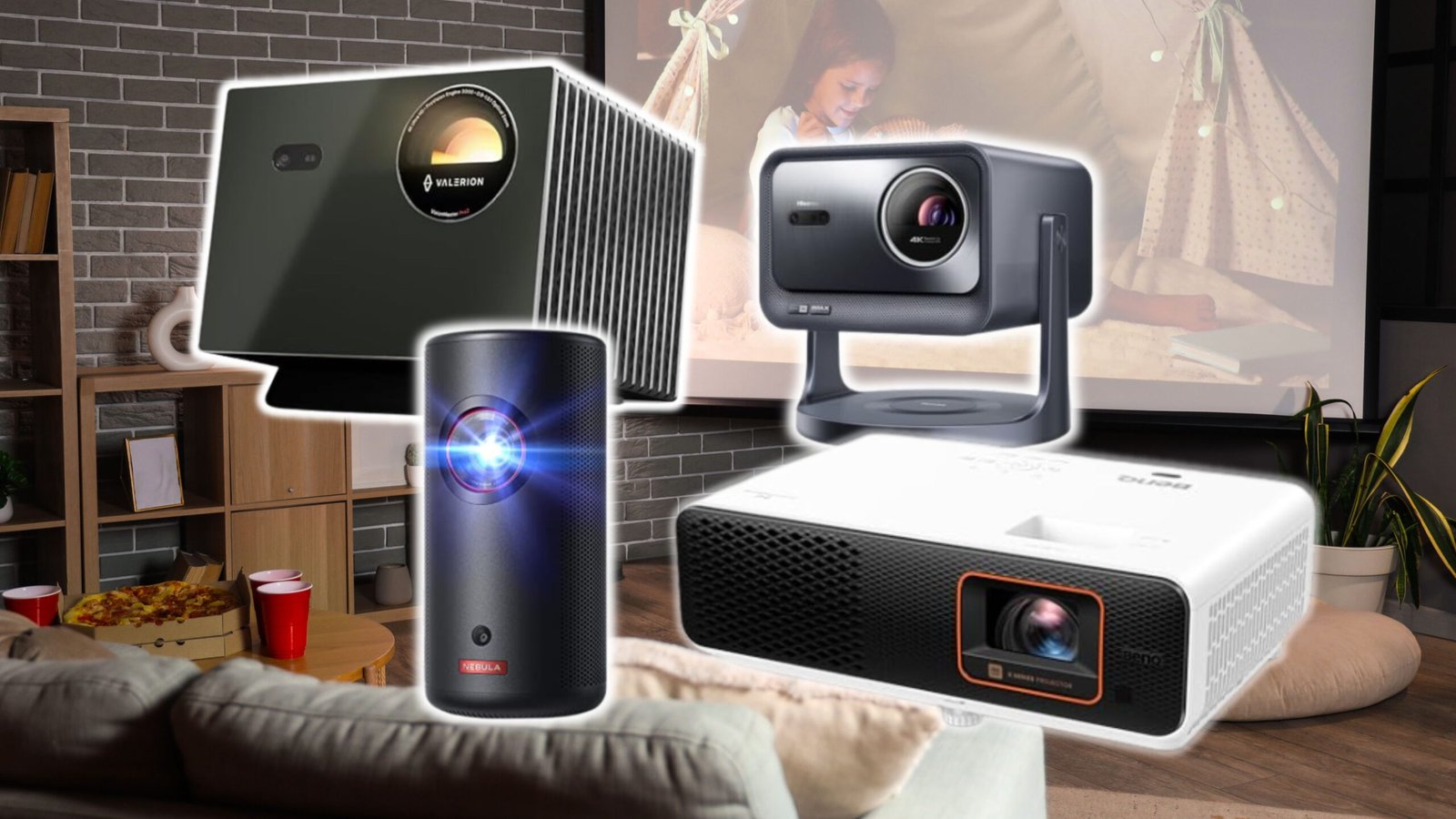
After extensively researching and comparing this current market — spanning premium lifestyle projectors, portable machines, a dedicated gaming projector, and one proper home cinema workhorse — here’s what I’d actually recommend.
Quick Comparison: Best 4K Projectors for Home Cinema UK
| Projector | Best For | Resolution | Brightness | Price |
|---|---|---|---|---|
| Valerion VisionMaster Pro2 | Premium home cinema | 4K (DLP + XPR) | 3,000 ISO Lumens | Check Price |
| Hisense C2 Pro | Best all-rounder | 4K (pixel-shift) | 2,600 ANSI | Check Price |
| Nebula Capsule 3 | Budget portable | 1080p | 200 ANSI | Check Price |
| XGIMI MoGo 4 Laser | Best portable | 1080p | 550 ISO Lumens | Check Price |
| BenQ X500i | Gaming + home cinema | True 4K | 2,200 ANSI | Check Price |
Individual Product Reviews
1. Valerion VisionMaster Pro2 — Premium RGB Laser Home Cinema Projector

3000 ISO Lumens, 15000:1 Contrast, 0.9-1.5x Optical Zoom, HDR10+, 4ms Low Input Lag, Controlled Smart Home Systems
Valerion VisionMaster Pro2 | 4K HDR RGB Triple Laser Lifestyle Projector with 3,000 ISO Lumens, Dolby Vision, Google TV, HDMI 2.1
We earn a commission if you make a purchase, at no additional cost to you.
Price range: ~£2,500–£2,800 Best for: Dedicated home cinema rooms, serious enthusiasts who want premium picture quality without a six-figure budget
Key Specifications
- Technology: DLP, Texas Instruments 0.47″ DMD chip + XPR 4K pixel-shifting
- Light Source: RGB Triple Laser (rated 25,000+ hours)
- Brightness: 3,000 ISO Lumens
- Contrast: 4,000:1 native / 15,000:1 dynamic
- Colour Gamut: 107% of Rec. 2020
- Throw Ratio: 0.9–1.5:1 (motorised optical zoom)
- HDR Support: Dolby Vision, HDR10, HDR10+
- Smart Platform: Google TV (built-in)
- Audio: DTS Virtual X with WiSA 7.1-channel wireless audio support
- Connectivity: 2x HDMI 2.1 + 1x HDMI 2.1 eARC
- Weight: ~7kg
What Works Well
Valerion is a sister company of AWOL Vision — well-known for their high-end laser TVs — and the engineering pedigree shows. The VisionMaster Pro2 arrives in proper protective packaging and feels like a premium product from the moment you open the box. The metal-ribbed chassis is genuinely handsome, and the build quality sits several notches above most lifestyle projectors at this price point.
The RGB triple-laser light source is the headline feature, and rightly so. In real-world testing, colours are vivid and accurate in a way that single-blue laser projectors simply cannot match — you’re getting over 107% of the Rec. 2020 colour space, which means natural skin tones, deep reds, and greens that don’t clip into neon territory. SDR and HDR content both look impressive straight out of the box with minimal calibration required, and dark scenes genuinely hold their own rather than disappearing into grey mush.
The motorised lens with 0.9–1.5:1 optical zoom is a practical feature that home cinema buyers will genuinely appreciate. Installation flexibility is real — you’re not locked into one precise throw distance, and the motorised operation makes fine-tuning from your seating position straightforward. The HDMI 2.1 ports with eARC support mean you can connect modern consoles, a soundbar, or a receiver without any adaptor faff.
WiSA compatibility for 7.1-channel wireless audio is genuinely rare at this price and makes the Pro2 a more flexible foundation for a proper home theatre setup than competitors with fixed speaker systems.
Downsides / Limitations
At roughly 7kg and without a built-in battery, this is not a portable projector — it’s a room-installation piece. The Enhanced Black Level (EBL) feature, designed to deepen contrast, currently produces a noticeable colour shift when activated, which breaks immersion in dark scenes. Valerion are aware of this and firmware updates may address it, but as of now it’s best left switched off.
It’s also pricier than the Hisense C2 Pro for broadly similar specs, and the US-origin pricing means UK availability and value can fluctuate. The cover concealing the rear ports is a nice aesthetic touch, but it means you can’t even plug in power with it in place — slightly baffling design choice.
Who Should Buy It
Enthusiasts building or upgrading a dedicated home cinema room who want a projector that delivers genuine cinema-grade colour accuracy without spending £5,000+. If you want proper RGB laser performance, WiSA audio flexibility, and a projector that looks as impressive sitting on a shelf as it does on a screen, the Pro2 is the one to beat.
Honest Verdict
The best picture quality in this roundup when conditions are right, but you’re paying a premium and the EBL feature needs improvement. Outstanding value if you can stomach the price — falls short of truly perfect due to that contrast feature caveat.
Rating: 9/10
2. Hisense C2 Pro — Best All-Round 4K Smart TV Projector for Home Cinema

Hisense C2 Pro | 4K Trichroma Laser Mini Projector, 2,600 ANSI Lumens, Dolby Vision & IMAX Enhanced, JBL Audio, VIDAA Smart OS, Gimbal Stand
We earn a commission if you make a purchase, at no additional cost to you.
Price range: ~£2,199 Best for: Anyone wanting the best all-in-one smart TV projector for home cinema use — outstanding image, powerful audio, dead-simple setup
Key Specifications
- Technology: DLP, 1080p native with pixel-shifting at 240Hz to 4K
- Light Source: Trichroma Triple Laser (MCL38, 28-chip design)
- Brightness: 2,600 ANSI Lumens
- Throw Ratio: 0.9–1.5:1 (optical zoom)
- HDR Support: Dolby Vision, IMAX Enhanced, HDR10+
- Colour Gamut: 110% BT.2020
- Gimbal Stand: 360° horizontal, 90° up / 45° down vertical
- Smart Platform: VIDAA OS (Netflix, YouTube, Prime Video built-in)
- Audio: 20W 2-channel JBL
- Connectivity: HDMI 2.0 (with ARC), USB
What Works Well
The Hisense C2 Pro is the projector I’d recommend to most people reading this guide — and that’s not a hedge. It delivers the best image quality I’ve seen from a compact one-box home cinema projector at this price, full stop.
Yes, it’s technically pixel-shifting from a native 1080p chip to achieve its 4K output, but the 240Hz pixel-shift implementation is so convincing that, in practice, you will not be able to tell the difference from a true 4K source at normal viewing distances. The Trichroma triple laser engine — using 28 individual laser chips — produces colour depth and accuracy that’s immediately apparent compared to cheaper projectors. Colours are rich without being garish, HDR highlights punch convincingly, and even tricky dark scenes retain detail rather than collapsing.
The integrated gimbal stand is genuinely brilliant for flexibility. Being able to swing 360° horizontally and tilt up to 90° means you can project onto a ceiling while lying in bed, point it at an unusual wall, or position it on a table in a non-standard layout without any additional mounts. For anyone setting up in a typical UK living room — which often doesn’t conform to textbook home cinema geometry — this is a real-world advantage.
The built-in 20W JBL 2.0 system is more than capable for casual and semi-serious home cinema use. It can go impressively loud, though it’s best kept below 50% where bass can get murky. Most importantly, it means you can have a proper cinema experience without immediately needing a separate sound system.
IMAX Enhanced and Dolby Vision certification confirm this isn’t just marketing — content mastered for those formats actually benefits from the projector’s capabilities.
Downsides / Limitations
UK catch-up TV apps (BBC iPlayer, ITVX, Channel 4) are absent from VIDAA OS — a frustrating omission that may improve with firmware updates, but it’s a real gap for UK buyers who rely on free-to-air streaming. You’ll need a streaming stick or console plugged in to fill that gap.
Audio quality drops off at high volumes, and at £2,199 this is not a casual purchase. Native resolution being 1080p rather than true 4K will bother some purists, though real-world image quality makes this a theoretical rather than practical concern.
Who Should Buy It
This is the best 4K projector for home cinema in the UK for anyone who wants exceptional all-in-one performance without the complexity of a separate AV receiver and speaker system. Especially suits buyers who want flexibility in projector placement and genuinely impressive out-of-box picture quality.
Honest Verdict
The most complete all-round smart TV projector in this guide. Loses a point for missing UK streaming apps, but gains it back in pure image performance. The current class leader in compact home cinema projectors.
Rating: 9.5/10
3. Nebula Capsule 3 — Best Budget Portable Smart Projector
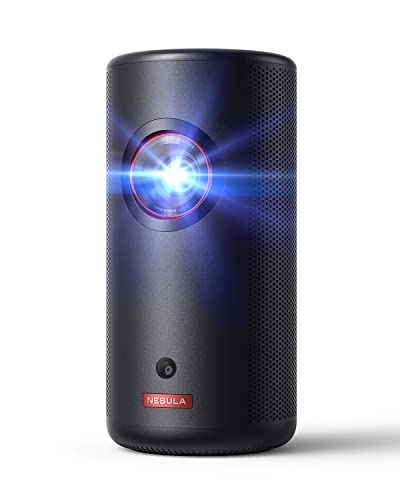
Upgraded with Google TV and Official Netflix, Mini Smart TV Projector with Wi-Fi, Outdoor Portable Projectors, Dolby Digital, 120-Inch Screen, 2.5H Built-In Battery
Nebula Capsule 3 | 1080p Mini Smart Projector with Official Google TV, Built-in Netflix, 200 ANSI Lumens, 120-Inch Picture, 2.5-Hour Battery
We earn a commission if you make a purchase, at no additional cost to you.
Price range: ~£370–£499 Best for: Budget-conscious buyers who want a genuinely portable, easy-to-use smart projector for indoor movie nights in darker rooms
Key Specifications
- Technology: DLP
- Light Source: LED
- Brightness: 200 ANSI Lumens
- Native Resolution: 1080p (1920×1080)
- Max Screen Size: 120 inches
- Battery Life: Up to 2.5 hours video playback
- Smart Platform: Google TV (native Netflix, Disney+, Prime Video, YouTube)
- Audio: 8W mono speaker, Dolby Digital+
- Connectivity: HDMI, USB-A, Wi-Fi 5, Bluetooth
- Dimensions: 80mm diameter × 160mm tall
- Weight: ~960g
What Works Well
There’s a reason the Nebula Capsule has been on best portable projector lists since the beginning — Anker understands that portability is a genuine lifestyle feature, not a spec on a sheet. The Capsule 3 is genuinely small. It’s the size of a fat drinks can, slips into a bag without complaint, and the auto-focus and auto-keystone correction mean you really can point it at a surface and watch a film within 60 seconds.
The jump to Google TV over the older Android TV software is significant. All major UK streaming services work as they should — Netflix is natively supported, which has historically been a headache with portable projectors, and the Google TV interface is polished, intuitive, and genuinely usable. Voice search via the included remote is a step up from jabbing at an on-screen keyboard.
The 1080p output looks genuinely crisp in a darkened room on a 60–80 inch image, and the built-in 8W speaker handles audio better than the diminutive size suggests. Dolby Digital+ decoding means streaming audio quality is solid.
At its sub-£400 regular price point, there’s nothing else that packs this combination of portability, smart platform quality, and ease of use.
Downsides / Limitations
Let’s be straight: 200 ANSI lumens is not much light. This projector requires a properly darkened room to look good. Even curtains half-open will wash it out noticeably, and daytime use is essentially not viable. Battery life drops by around 40% when unplugged from the mains — significant for outdoor use.
There’s no HDR, no wide colour gamut, and the contrast is modest. This is not a projector for critical cinephile viewing — it’s a convenience and lifestyle product. The Laser version of the Capsule 3 (sold separately) ups brightness to 300 ANSI lumens but costs more and runs older Android TV software without native Netflix support, making the standard Capsule 3 the smarter buy for most.
Who Should Buy It
Anyone wanting a grab-and-go home cinema experience for bedroom movie nights, camping trips, or student accommodation. Not for people expecting bright, vivid images in anything other than a properly dark room. Perfect for what it is — just know what it is before you buy.
Honest Verdict
The most convenient and complete portable projector under £500 in the UK right now. Don’t buy it expecting the performance of a £2,000 laser projector — but for its purpose, nothing else at this price touches it.
Rating: 8/10
4. XGIMI MoGo 4 Laser — Best Portable Projector with Laser Performance

550 ISO Lumens, 360 Built-in Stand, Built-in Battery, 2.5 Hours of Playtime, Google TV with Licensed Netflix, 2 6W Harman Kardon
XGIMI MoGo 4 Laser | Portable Projector, 550 ISO Lumens Triple Laser, 1080p, Google TV with Licensed Netflix, 360° Stand, 2.5-Hour Battery, 2×6W Harman Kardon
We earn a commission if you make a purchase, at no additional cost to you.
Price range: ~£599–£679 Best for: The portable projector buyer who wants laser-quality images in a genuinely portable package — the step up from the Capsule 3 for those who need more brightness
Key Specifications
- Technology: DLP
- Light Source: Triple Laser
- Brightness: 550 ISO Lumens
- Native Resolution: 1080p (Full HD)
- Contrast Ratio: 1,000:1
- Throw Ratio: 1.2:1
- Image Size: 40–200 inches (120in optimal)
- Battery Life: Up to 2.5 hours
- Smart Platform: Google TV (licensed Netflix, YouTube, Prime Video)
- Audio: 2×6W Harman Kardon (Dolby Digital)
- Connectivity: HDMI (with ARC), USB-A, USB-C (charging)
- Weight: ~900g
What Works Well
The MoGo 4 Laser takes everything the standard MoGo 4 does and makes it significantly more capable by swapping the LED light source for triple laser technology.
The result is 550 ISO Lumens — not spectacular in absolute terms, but nearly three times brighter than the Capsule 3, and the improved 1,000:1 contrast ratio means dark scenes actually have depth and dimension rather than looking murky.
The transforming design is genuinely clever. The top section rotates to point in any direction, allowing ceiling projection from flat on a table or standard wall projection at the right angle.
Pull the projector back into its body and the translucent base section doubles as a Bluetooth speaker with ambient lighting — the magnetic “creative filter” attachments slot over the lens to project atmospheric light patterns around the room. It’s a proper lifestyle product that goes beyond being just a projector.
XGIMI’s auto-setup features (Auto Keystone, Auto Focus, Intelligent Screen Fit, Obstacle Avoidance) work well in practice, making the MoGo 4 Laser one of the most convenient projectors to live with day-to-day.
The Harman Kardon 2×6W speakers are genuinely good — noticeably better than the Capsule 3’s mono setup, with stereo separation and Dolby Digital support.
Google TV is well-implemented with properly licensed Netflix, which has become the benchmark for portable projector smart platforms.
Downsides / Limitations
550 lumens still isn’t enough for bright room use — this is a projector that needs dim conditions to look its best, and daytime outdoor use will be a squinting experience. At around £677–£679, you’re paying a meaningful premium over the standard MoGo 4 (around £509) for the laser upgrade and extra filters; whether that’s worth it depends on how much you care about darker scene contrast and colour richness.
Catch-up TV apps for UK broadcasters (BBC iPlayer, ITVX, Channel 4) are absent, which mirrors the issue found across most Android/Google TV-based projectors at this price.
Battery life at 2.5 hours is just about adequate for most films but doesn’t leave much headroom.
This is 1080p, not 4K — for buyers specifically seeking the best 4K projector for home cinema, the MoGo 4 Laser is a supporting player rather than the main event.
Who Should Buy It
The buyer who found the Capsule 3 too dim but doesn’t need full home cinema 4K performance. Ideal for frequent movers, renters, anyone wanting a multi-room setup, or buyers who want their projector to double as a premium Bluetooth speaker and ambient lighting system.
Honest Verdict
Currently the best portable projector you can buy in the UK, full stop. The laser upgrade over its predecessor is meaningful, the design is inventive, and the smart platform is excellent.
Just be clear-eyed that it’s a lifestyle/portable product, not a substitute for the Hisense C2 Pro or Valerion in a dedicated home cinema.
Rating: 8.5/10
5. BenQ X500i — Best 4K Short-Throw Gaming Projector That Doubles as Home Cinema

4ms Response Time Auto Game Mode Xbox, PS5, Switch Supports eARC and S/PDF | FPS Crosshair | 5Wx2 Speaker
BenQ X500i | True 4K UHD HDR 4LED 2,200 Lumens Short-Throw Console Gaming Projector | 4ms Response Time | Auto Game Mode | Xbox, PS5, Nintendo Switch
We earn a commission if you make a purchase, at no additional cost to you.
Price range: ~£1,299–£1,499 Best for: Console gamers who want a massive 4K screen with genuinely low input lag — and the home cinema capability to back it up when gaming is done
Key Specifications
- Technology: DLP, True 4K (native 4K chip — not pixel-shifted)
- Light Source: 4LED (four LED pumps)
- Brightness: 2,200 ANSI Lumens
- Contrast: 3,000,000:1 (dynamic)
- Throw Ratio: ~0.496:1 (short-throw)
- Image Size: 60–150 inches (100in from ~1.5m)
- Input Lag: 4ms (at 4K/60Hz); very low at 240Hz
- HDR Support: HDR10, HLG, HDR10+
- Smart Platform: Android TV 11 (built-in Chromecast)
- Audio: TreVolo speaker system
- Connectivity: 3x HDMI 2.0 (1x eARC), USB-A, USB-C
- Light Source Life: 20,000+ hours
What Works Well
Here’s the reality about the BenQ X500i: it’s the most honest true-4K projector in this roundup. While the Hisense C2 Pro and Valerion Pro2 use pixel-shifting to hit their 4K resolution, the X500i uses a native 4K DLP chip — meaning every pixel is genuinely rendered at 3,840×2,160. That matters in practice when you’re gaming on a 100-inch screen and need sharp, accurate lines and text.
The short-throw optics are the other major practical win. A 100-inch image from just 1.5 metres — you only need a clear wall in an average-sized UK living room to get an enormous screen.
Gaming on a 120-inch image is a properly immersive experience that no TV can replicate at anything close to a sane price point.
Input lag performance is exceptional for a projector. BenQ’s gaming heritage shows — at 4K/60Hz you’re looking at 4ms, and even at 240Hz the measured latency is competitive with good gaming monitors rather than embarrassing in the way legacy projectors used to be.
Auto Game Mode automatically switches to gaming settings when a console is detected, which is a nice convenience feature.
The 4LED system produces vibrant colours with excellent out-of-box accuracy, and BenQ’s tuned presets are genuinely good — not the oversaturated mess you sometimes get from gaming-marketed products.
The TreVolo audio is better than average for a projector without a dedicated speaker system.
Downsides / Limitations
This is not the projector for serious film buffs. There’s no Dolby Vision or Dolby Atmos support, which is a genuine omission at £1,499 — you’re relying on HDR10 and HLG.
If you’re buying specifically as a home cinema projector for film watching, the Hisense C2 Pro delivers a richer, more cinematic HDR experience.
At 2,200 ANSI lumens it handles moderately dim rooms acceptably but struggles in anything approaching normal daytime living room conditions.
The Android TV 11 smart platform is functional but not as polished as Google TV on the XGIMI or VIDAA on the Hisense. Menu navigation can feel sluggish — a known BenQ quirk that reviewers have flagged consistently.
At £1,499 you’re also spending more than you might expect for “just” a gaming projector — though the comparison becomes more flattering when set against premium gaming monitors or large 4K TVs with equivalent screen real estate.
Who Should Buy It
Console gamers — particularly PS5, Xbox Series X, and Switch players — who want the most immersive big-screen experience possible in a normal-sized room.
Also suits buyers who want a dual-purpose setup: gaming during the week, films at the weekend, without compromising too heavily on either. The truest 4K picture in this roundup.
Honest Verdict
Exceptional gaming projector that doesn’t embarrass itself watching films. Missing Dolby Vision and Atmos is a genuine gap, and the lack of those certifications means film purists should look at the Hisense C2 Pro instead. But for gaming? Nothing else in this guide comes close.
Rating: 8.5/10
Buying Guide: How To Choose the Best 4K Projector for Home Cinema
Real 4K vs Pixel-Shifted 4K — Does It Actually Matter?
This is the number one question to understand before you spend a penny. True native 4K projectors (like the BenQ X500i) have a chip with four times the pixels of 1080p.
Pixel-shifted 4K (Hisense C2 Pro, Valerion Pro2) starts from a 1080p chip and rapidly shifts pixels to create a 4K-equivalent image.
At normal viewing distances on screens up to 120 inches, most people genuinely cannot tell the difference. Pixel-shifting technology has matured significantly, and at 240Hz the result is highly convincing.
Where true 4K has a measurable advantage is in sharp, high-contrast content like fine text, geometric precision, and close-up gaming. If films are your priority, pixel-shifted 4K is entirely sufficient. If gaming or ultra-fine detail matters, native 4K is worth seeking out.
Brightness: What the Numbers Actually Mean
Lumen figures are where projector marketing becomes most misleading. There are multiple brightness standards (ANSI lumens, ISO lumens, manufacturer-claimed lumens) and they’re not always equivalent.
The practical rule: for a fully darkened room with blackout curtains, 300–600 lumens can produce a good image. For a room with ambient light (typical UK living room in the evening), you want 1,500+ ANSI lumens as a minimum.
For rooms that might have daytime viewing or curtains that don’t fully close, 2,000+ is advisable. No projector under £2,000 currently handles full daytime ambient light convincingly.
Contrast Ratio: The Real Driver of Perceived Quality
A common mistake is prioritising lumens over contrast. High contrast is what makes blacks look truly black and gives HDR content its punch.
Dynamic contrast figures (like 15,000:1 on the Valerion Pro2) are marketing — native contrast (4,000:1 on the same projector) is what matters in practice. Triple laser projectors generally have better contrast than single-laser or LED alternatives.
Smart TV Platform: Don’t Underestimate This
In 2025, a projector without a capable smart TV platform built in is an inconvenience. Google TV (XGIMI, Nebula) is currently the best experience — it has all UK streaming apps including natively licensed Netflix, a polished interface, and Google Assistant.
Hisense’s VIDAA OS is functional with Dolby Vision apps but notably lacks UK catch-up TV (BBC iPlayer, etc.). Android TV 11 (BenQ X500i) is serviceable but increasingly showing its age.
Check which streaming apps matter to you before buying — if BBC iPlayer or ITVX are daily watches, confirm they’re available on the platform.
Throw Ratio: Match the Projector to Your Room
Standard throw projectors (1.2:1 and above) need distance from the screen — roughly 2.5–3 metres for a 100-inch image. Short-throw projectors (0.5:1 and below) can achieve large images from under a metre away.
Most of the projectors in this guide fall into the 0.9–1.5:1 range — they’re not short-throw UST projectors, but they’re flexible enough for most UK room sizes.
What Actually Matters vs Marketing Fluff
Matters: Native contrast, colour gamut coverage (% of Rec. 2020 or DCI-P3), throw ratio for your room, smart platform, HDR format support (Dolby Vision is genuinely superior to HDR10+ for compatible content)
Largely marketing: Peak lumen figures without ISO/ANSI qualification, maximum image size (120″ in a living room is impractical for most buyers), “HDR Ready” labelling without Dolby Vision certification
Common Mistakes To Avoid
Buying for the biggest number on the box. A 5,000-lumen projector with terrible contrast and no smart platform will disappoint more than a 2,600-lumen projector with excellent colour accuracy.
Underestimating ambient light in your room. Most buyers, when asked, overestimate how dark they keep their viewing room. Test with your actual curtains/blinds before deciding you need only 400 lumens.
Ignoring the smart platform. Buying a projector and then plugging in a separate Fire Stick or Chromecast to get Netflix working properly is annoying and avoidable — check the platform carefully.
Assuming “4K” means the same thing across products. As discussed above, native vs pixel-shifted 4K are genuinely different. Neither is necessarily better for your use case, but understand what you’re buying.
Overlooking the audio. Many buyers immediately assume they’ll connect a separate speaker system, then never get around to it. Projectors with quality built-in audio (JBL on the Hisense C2 Pro, Harman Kardon on the MoGo 4 Laser) let you enjoy the full experience from day one.
Not accounting for long-term bulb/laser costs. Traditional lamp projectors need bulb replacements every few thousand hours. All five projectors in this guide use LED or laser light sources with 20,000–30,000-hour lifespans — effectively eliminating this ongoing cost.
This is actually a major long-term ownership advantage that justifies their higher upfront prices over cheaper lamp-based models.
Buying a portable projector expecting stationary home cinema performance. The Nebula Capsule 3 is not a home cinema projector. The XGIMI MoGo 4 Laser is not a home cinema projector. They’re brilliant at what they do, but they’re different products serving different needs
Final Verdict: Which Is the Best 4K Projector for Home Cinema UK?
Best Overall: Hisense C2 Pro
~£2,199 | Check Price on Amazon
After comparing all options, the Hisense C2 Pro is the best all-round smart TV projector for home cinema in the UK in 2025.
The Trichroma triple laser engine delivers exceptional colour and contrast, IMAX Enhanced and Dolby Vision certification are genuine quality markers, the gimbal stand makes installation genuinely flexible, and the built-in JBL audio means you can have a complete cinema experience without day-one investment in additional equipment.
The missing catch-up TV apps are an irritation but a manageable one. For anyone building or upgrading a home cinema, this is the projector I’d point them towards first.
Best Premium Pick: Valerion VisionMaster Pro2
~£2,500–£2,800 | Check Price on Amazon
For dedicated home cinema enthusiasts who want the best picture quality available at a non-stratospheric price, the Valerion VisionMaster Pro2 is genuinely impressive. Its RGB triple laser with 107% Rec. 2020 coverage, WiSA audio compatibility, and HDMI 2.1 connectivity make it the most future-proof and audiophile-flexible projector in this group.
The EBL contrast feature needs refinement, but the overall package is extraordinary value compared to projectors that cost twice as much.
Best Gaming Projector: BenQ X500i
~£1,299–£1,499 | Check Price on Amazon
If your primary use case is gaming — particularly on PS5 or Xbox Series X — the BenQ X500i is the clear recommendation. True 4K, short-throw optics, ultra-low input lag, and vibrant 4LED colour make it the definitive gaming projector in this roundup. It handles films competently too, just without the Dolby Vision polish of the Hisense C2 Pro.
Best Portable: XGIMI MoGo 4 Laser
~£599–£679 | Check Price on Amazon
The best portable projector on the market right now. Triple laser technology lifts image quality meaningfully over LED alternatives, the transforming design is genuinely clever, and Google TV with licensed Netflix means it works out of the box without compromise. Worth the premium over the standard MoGo 4.
Best Budget Pick: Nebula Capsule 3
~£370–£499 | Check Price on Amazon
If budget is the primary constraint and a darkened room is available, the Nebula Capsule 3 remains the best sub-£500 projector you can buy.
Google TV with native Netflix, a proper 1080p image, and a battery-powered design that genuinely goes anywhere.
Don’t let anyone tell you 200 lumens is fine in a bright room — it isn’t — but in the right conditions, this thing punches well above its weight and price.
Prices correct at time of publication. Always verify current pricing on Amazon before purchasing. We earn a commission on qualifying purchases at no additional cost to you.