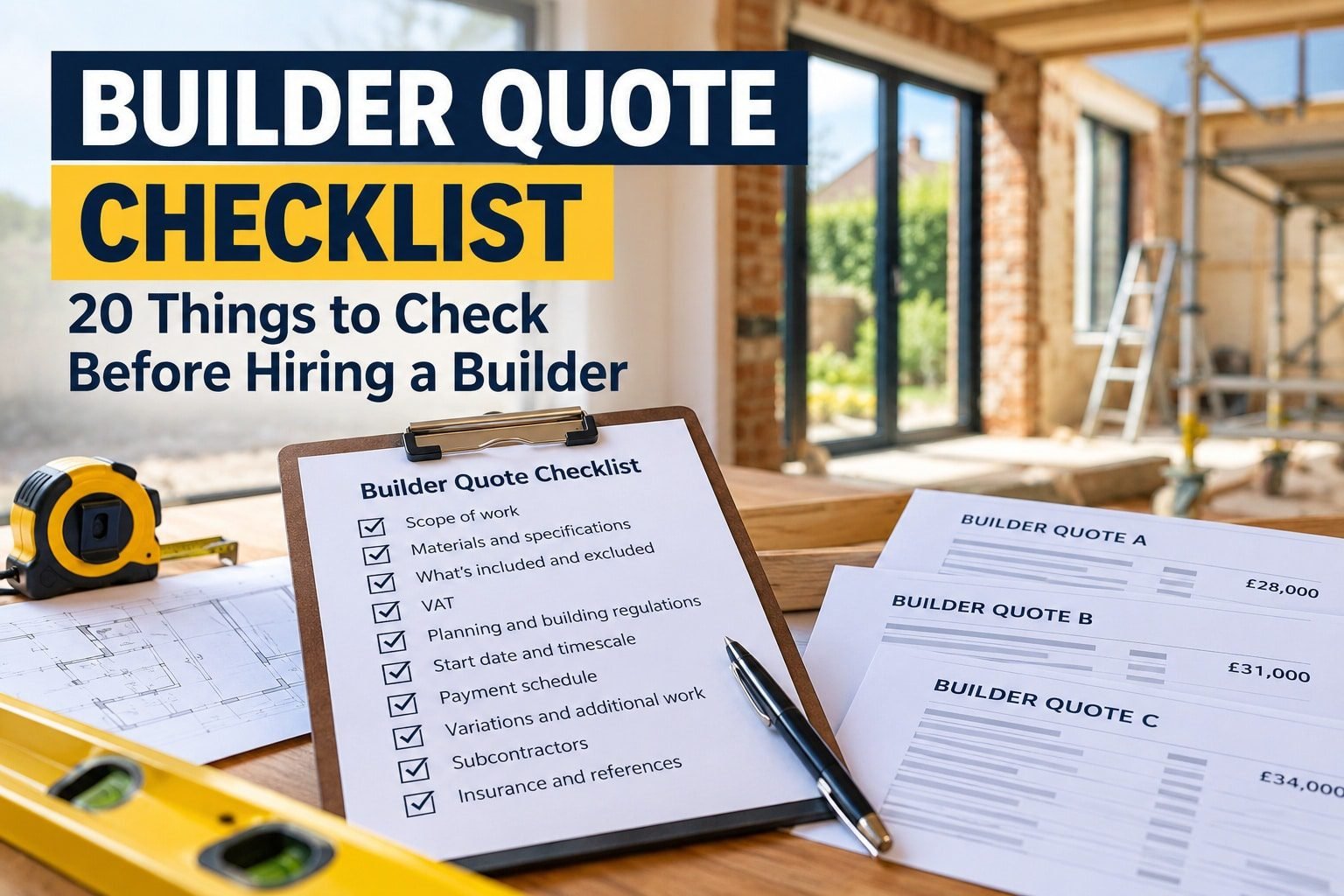
Builder Quote Checklist at a glance:
- Get at least three written quotes and give each builder the same specification so you can compare like for like.
- Check exactly what the price includes, particularly materials, waste removal, scaffolding, plumbing, electrics, making good and VAT.
- Establish how additional work will be agreed and priced before the project starts.
- Agree payment stages, start dates and expected completion times in writing.
- Check the builder as carefully as the price, including references, insurance and relevant registrations.
Getting a builder’s quote can feel straightforward until you put three quotes next to each other and realise they cover three slightly different jobs.
One builder may include waste removal, decorating and electrical work. Another may leave them out. A third might use allowances for materials that eventually cost considerably more.
That’s why a builder quote checklist is useful. You aren’t simply looking for the lowest number at the bottom of the page. You need to establish exactly what you’re getting for your money and what could cost extra later.
I’ve dealt with builders and other tradespeople across my own property renovations and maintenance over the years.
My approach is to get three itemised quotes and compare them like for like. The detail matters because missing work can make a cheaper quote look much better than it really is.
Builder Quote Checklist: What Should You Check?
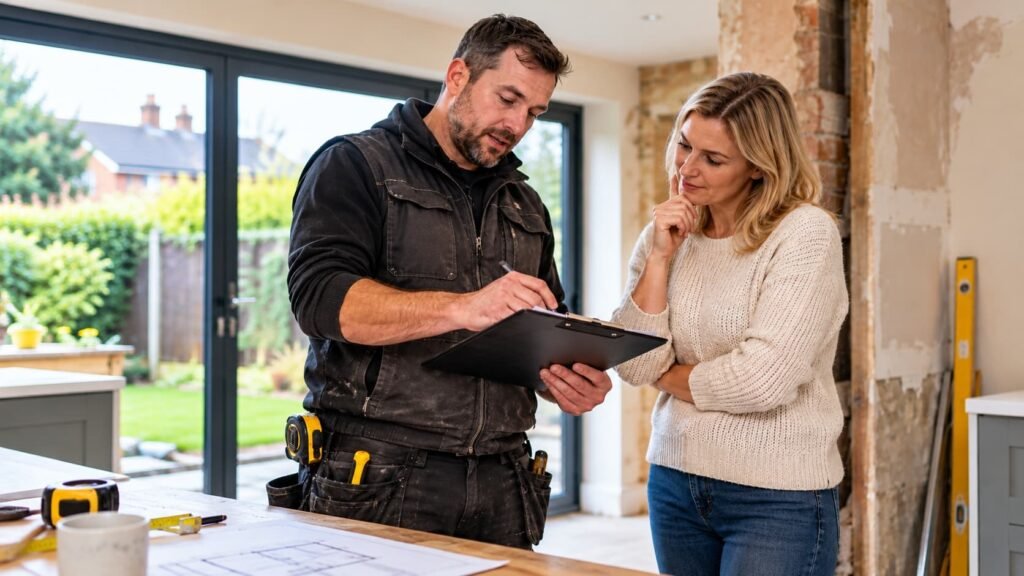
Before accepting a builder’s quote, check the scope, price, materials, exclusions, VAT, timescale, payments and responsibility for any additional work.
Here’s our 20-point builder quote checklist:
- Is it a written quote rather than a verbal price?
- Is the complete scope of work described?
- Is there a fixed total price?
- Are labour and materials clearly accounted for?
- Are important materials and specifications identified?
- Are provisional sums or allowances explained?
- Does the price include VAT, where applicable?
- Are waste removal and skips included?
- Are scaffolding and equipment hire included?
- Is making good and decorating included?
- Are plumbing and electrical works included?
- Are subcontractors included in the price?
- Are planning, building control or professional fees included or excluded?
- Are the expected start date and project duration stated?
- Is there a clear payment schedule?
- Is the deposit, if required, clearly stated?
- Is there a written process for additional work and variations?
- Does the quote state how long the price remains valid?
- Are guarantees or warranties clearly described?
- Are exclusions clearly listed?
Citizens Advice recommends getting written quotes from at least three traders. Its guidance says a quote should include a fixed total price, a breakdown of work and materials, separate costs, how long the price remains valid, whether VAT is included and when the price can increase.
Citizens Advice also recommends checking insurance and getting a written contract.
That gives you a solid starting point.
Should You Get More Than One Builder Quote?
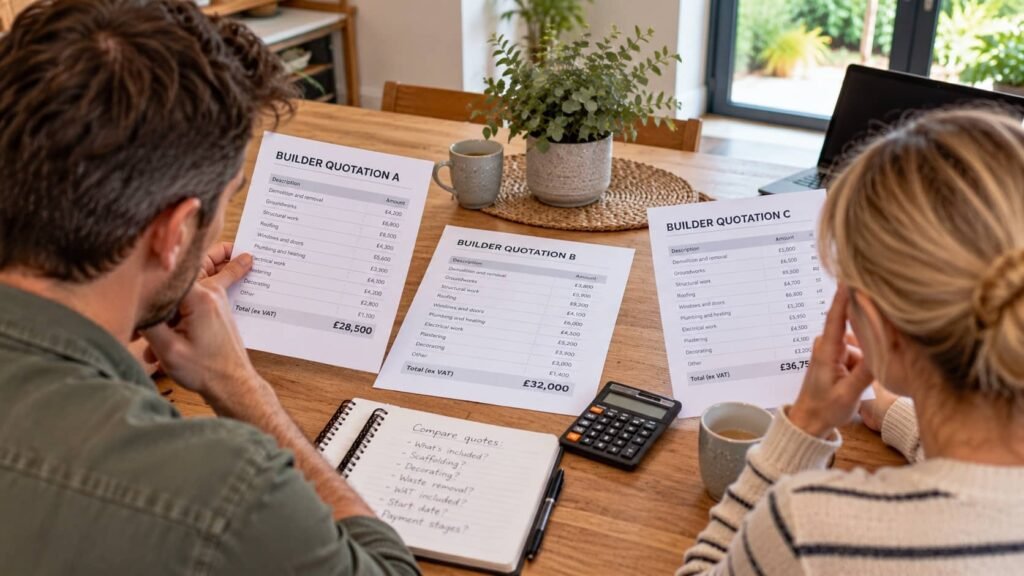
You should normally get several written builder quotes before deciding who gets the job. Citizens Advice recommends trying to obtain quotes from at least three different traders.
Three quotes give you something to compare. More importantly, they can expose differences in what each builder has actually included.
I’ve found that comparing like for like matters more than simply lining up three totals and picking the lowest.
For example:
Builder A: £28,000
Builder B: £31,000
Builder C: £34,000
Builder A initially looks £6,000 cheaper than Builder C. But suppose A hasn’t included decorating, waste removal, scaffolding or some electrical work while C has.
You don’t really have a £6,000 difference.
Before asking builders to quote, write a detailed description of the job and give the same information to everyone. Plans, specifications and fixture choices should also be consistent where available.
Price matters, but it shouldn’t be the only factor. GOV.UK’s guidance on the Consumer Rights Act makes the useful point that consumers should be able to compare important contract terms and consider the best overall offer rather than simply the cheapest.
If you’re still choosing contractors, read our guide to finding a reputable builder.
Is a Builder’s Quote the Same as an Estimate?
No. A quote and an estimate are different, and you should establish which one you’re receiving.
Citizens Advice describes a quote as an agreed price for the work, while an estimate is a rougher indication of likely cost. Its quotation guidance also explains circumstances in which a quoted price may change, including where you request additional work or agree to necessary extra work.
Look for the word “quote” or “quotation” rather than assuming every document containing a price is a fixed quotation.
Also check how long the price remains valid. Building projects can start months after quotations are prepared, so you need to know whether the builder has placed a time limit on the quoted price.
Does the Quote Clearly Describe the Work?
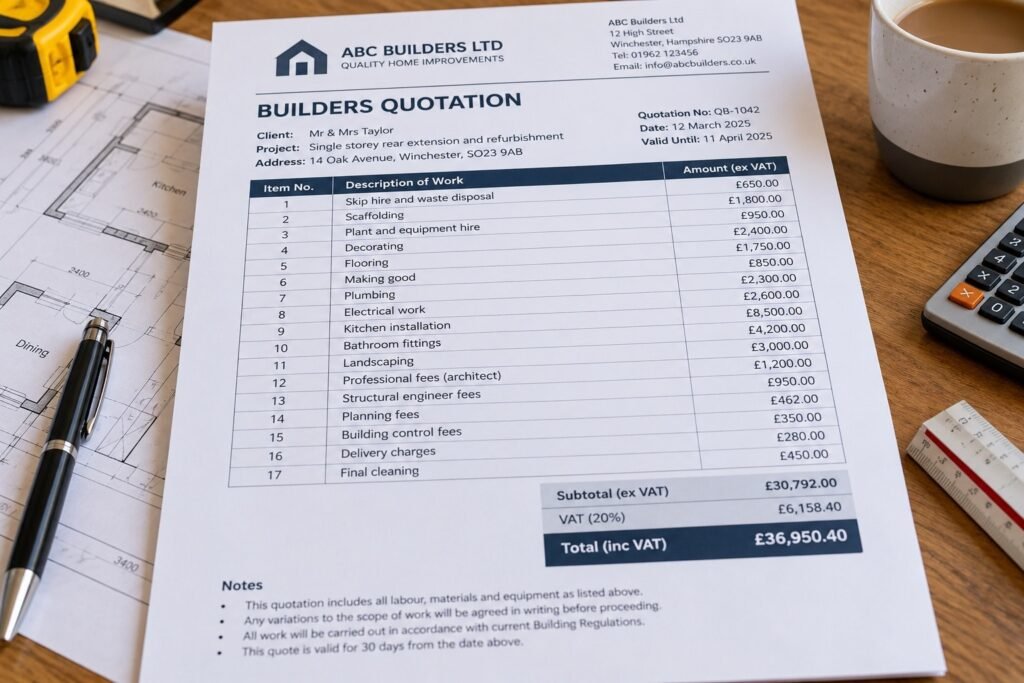
A useful quote should tell you what the builder is going to do rather than giving you a price attached to a vague description.
“Extension works: £37,000” doesn’t tell you very much.
Depending on the project, a detailed scope might cover:
- Site preparation and protection
- Demolition
- Excavation and groundworks
- Foundations
- Drainage
- Structural work
- Brickwork
- Roofing
- Windows and doors
- Insulation
- Plastering
- Carpentry
- Plumbing
- Electrical work
- Heating
- Flooring
- Decorating
- Waste removal
- Final making good
The exact list will depend on your project.
The principle is simple. You should be able to read the quote and understand what work the builder has priced.
For larger projects, detailed drawings and specifications can make quotations easier to compare because each contractor has a clearer description of what they’re pricing.
If you’re planning substantial work, our property renovation section provides further information on renovation projects.
Are Materials and Specifications Included?
The quote should make clear which important materials and specifications have been allowed for.
“Supply bathroom” is vague.
What bathroom?
The difference between basic and higher-specification sanitaryware, taps, tiles and fittings can be considerable.
The same principle applies to kitchens, flooring, doors, windows, roof coverings, insulation and electrical fittings.
Check Specifications
Where the choice matters, look for enough information to identify what has been priced.
Depending on the job, that might include the manufacturer, product range, quantity, size, finish or another useful specification.
You don’t necessarily need every screw listed. You do need enough detail to understand what you’re buying.
Look for Allowances and Provisional Sums
Pay attention to provisional sums and allowances.
For example, a builder might include an allowance of £25 per square metre for tiles. If the tiles you later choose cost £45 per square metre, your final material cost will rise.
Ask what each allowance covers and whether the figure is realistic for the standard you expect.
Establish Who Buys Fixtures and Fittings
You should also know whether you or the builder will order items such as sanitaryware, kitchen appliances, tiles and flooring.
That decision affects price, delivery responsibility and potentially the project timetable.
What Isn’t Included in the Builder’s Quote?
Exclusions can matter as much as inclusions. Ask the builder to state clearly what isn’t covered by the quoted price.
This is an area I pay particular attention to when comparing builders.
Check:
- Skip hire and waste disposal
- Scaffolding
- Plant and equipment hire
- Decorating
- Flooring
- Making good
- Plumbing
- Electrical work
- Kitchen installation
- Bathroom fittings
- Landscaping
- Professional fees
- Structural engineer fees
- Planning fees
- Building control fees
- Delivery charges
- Final cleaning
Citizens Advice recommends that written contracts address details including tidying up, rubbish removal, skip costs, materials, equipment and subcontractors.
Don’t assume something is included because you think it is an obvious part of the job.
Ask.
Does the Builder Quote Include VAT?
Check whether VAT is included in the figure you’re comparing.
Citizens Advice specifically lists VAT status as information that should appear on a quote.
Don’t assume every builder has the same VAT position. Ask each contractor to make the position clear and compare the actual amount you’ll need to pay.
A £30,000 figure and a £30,000 figure plus VAT are obviously not equivalent quotations.
Who Is Responsible for Planning and Building Regulations?
Establish who is responsible for permissions, approvals and associated fees before accepting the quote.
Planning permission and building regulations are separate systems. GOV.UK confirms that building regulations approval is different from planning permission and that some projects may require both.
Depending on the project, clarify responsibility for:
- Planning applications
- Building control applications
- Architectural drawings
- Structural calculations
- Building control fees
- Inspections
- Completion documentation
- Relevant certificates
Don’t assume a builder’s quotation includes these simply because they’re necessary for your project.
The requirements also depend on the work and where you live. Rules differ across the UK. Check the current requirements that apply to your property before work begins.
If you’re considering an extension in England, our guide to planning permission explains the distinction in more detail.
Are Party Wall Costs Included?
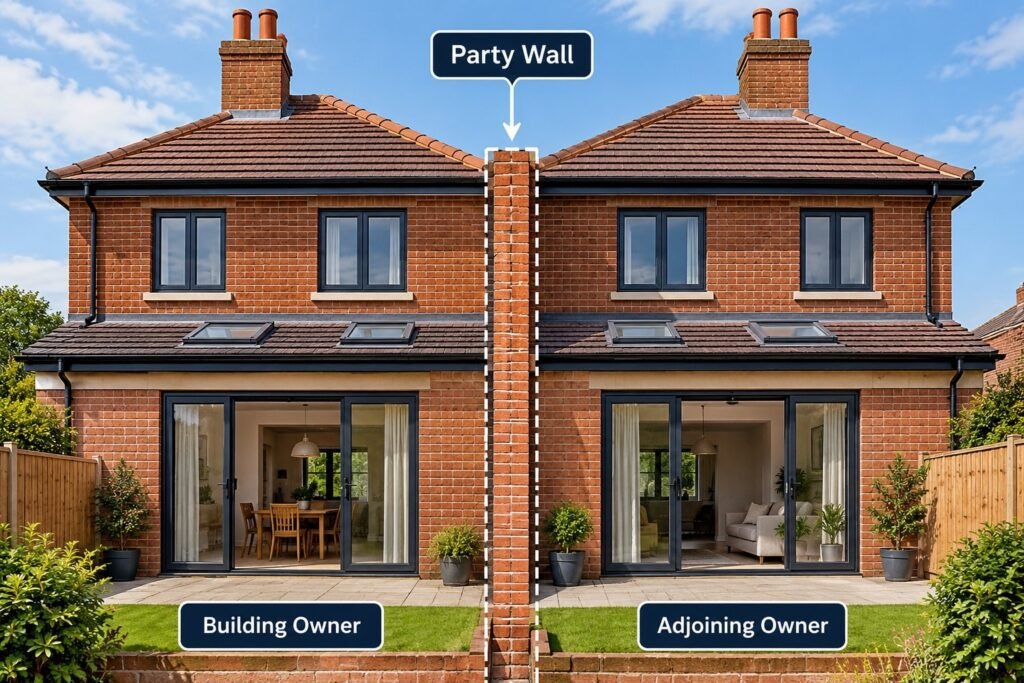
Party Wall matters may sit completely outside the builder’s quotation, so establish whether they affect your project before work starts.
For England and Wales, GOV.UK guidance explains that certain work on or near a shared property boundary or party wall requires you to notify neighbours. It also confirms that Party Wall requirements are separate from planning permission and building regulations.
This doesn’t mean every extension or renovation needs a Party Wall agreement.
The type and position of the proposed work matter. Scotland also has different rules.
If your project is potentially affected, establish whether surveyor fees or other Party Wall costs are outside your building budget.
Our guide to party wall agreements covers this subject separately.
Does the Quote Give a Start Date and Completion Timescale?
A good agreement should tell you when the builder expects to start and how long the project should take.
Check for:
- Proposed start date
- Expected duration
- Expected completion date, where appropriate
- Known dependencies
- Long-lead materials
- How delays will be handled
- How changes affecting the timetable will be communicated
Citizens Advice recommends that a written contract covers start and finish dates and how delays will be dealt with.
Be realistic about dates. Weather, hidden defects, supply problems and agreed changes can affect a building programme.
What you want to avoid is having no agreed timetable at all.
How Should Builder Payments Be Structured?
Your payment schedule should be agreed before work begins and written down.
For larger projects, staged payments can link payments to agreed points in the work rather than handing over most of the money before meaningful progress has been made.
That’s also the approach I’ve preferred when dealing with building and renovation work. Where appropriate, I want payments linked to progress, and I’d be cautious about pressure to make a large cash payment upfront.
Citizens Advice recommends agreeing how and when payments will be made, paying in stages and avoiding paying everything upfront. Its current guidance also recommends card payment where possible, followed by bank transfer rather than cash.
The right arrangement depends on the project and contract, but you should understand:
- Whether a deposit is required
- What the deposit covers
- When each payment becomes due
- What progress triggers each payment
- How additional work will be charged
- When the final payment becomes due
Get receipts and maintain a record of every payment.
What Happens If the Building Work Changes?
Agree a process for variations before the project starts.
A variation is a change to the agreed work. Sometimes you request it. Sometimes opening up an older property exposes a problem that wasn’t visible when the builder prepared the quote.
Before additional work proceeds, where practical, establish:
- What additional work is required
- Why it is required
- Additional labour cost
- Additional material cost
- Effect on the completion date
- Revised total price
Get the change in writing.
This reduces the chance of reaching the end of the job with two different recollections of what was agreed.
Has the Builder Included Subcontractors?
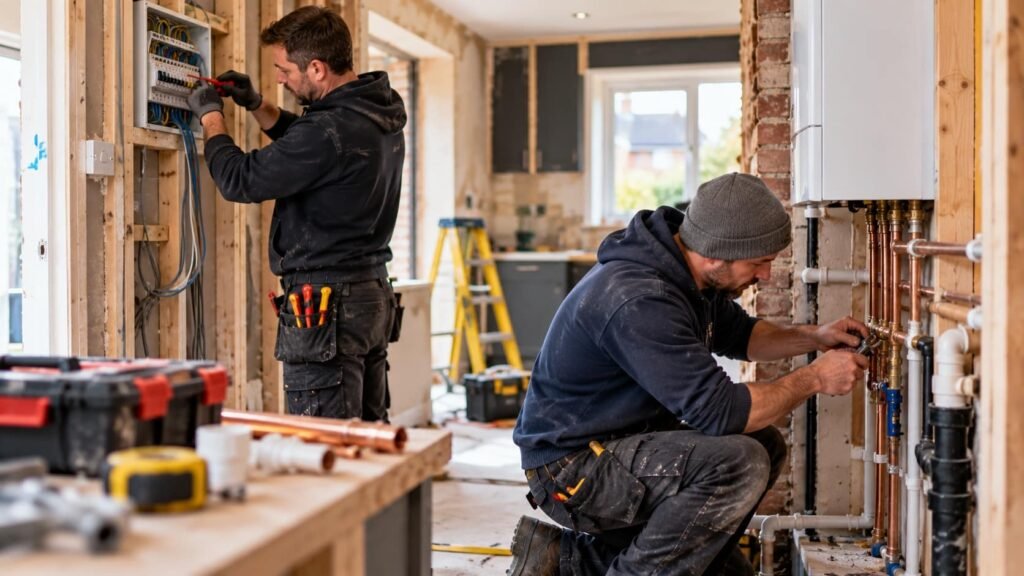
Ask which parts of the project the main builder will complete and which will be passed to subcontractors.
Depending on the project, subcontractors might include:
- Electricians
- Plumbers
- Heating engineers
- Roofers
- Plasterers
- Groundworkers
- Decorators
- Specialist installers
You need to know whether their work is included in the main quotation and who is responsible for paying and managing them.
For domestic construction projects, the HSE guidance also explains how duties under CDM 2015 normally pass to the contractor on a single-contractor project or principal contractor where more than one contractor is involved.
For most homeowners, the practical question for the quote is straightforward: who is managing the work, and is their cost included?
Have You Checked the Builder as Well as the Quote?
A detailed quotation doesn’t tell you everything about the person or company behind it.
Before committing, check the builder separately.
Look at:
- Recent examples of similar projects
- References from previous customers
- Appropriate insurance
- Relevant registrations where required
- Full business and contact details
- Who will supervise your project
- Who will actually carry out the work
Citizens Advice recommends asking for two or three recent examples of similar work and contacting previous customers rather than relying solely on written references.
Online ratings can help with initial research, but I wouldn’t use a review score as the deciding factor. References, completed work, insurance, credentials and the quality of the quotation tell you much more when considered together.
Should You Keep a Renovation Contingency?
Keeping money aside for unexpected work is sensible, particularly when renovating an older property where defects can remain hidden until work starts.
In my own property projects, I’ve found a contingency of around 10 to 15% useful. That isn’t a rule for every renovation. The appropriate amount depends on the building, scope of work and level of uncertainty.
Opening walls, lifting floors or removing an old kitchen can reveal problems that weren’t reasonably visible when the builder first visited.
A contingency is separate from accepting vague additional charges.
You should still ask what the extra work involves and how much it will cost.
For more help controlling a project budget, see our renovation budget.
Builder Quote Red Flags to Watch For
One warning sign doesn’t automatically mean you’ve found a bad builder. Several unresolved warning signs should make you investigate further before paying money or agreeing to work.
Be cautious about:
- A verbal quote with nothing in writing
- A very vague scope of work
- A price significantly below comparable quotes without a clear explanation
- Missing materials or important trades
- No clarification about VAT
- Pressure for a large upfront payment
- Pressure to pay cash
- No process for agreeing additional work
- No meaningful timetable
- Reluctance to provide references
- Unclear insurance
- Pressure to make an immediate decision
Citizens Advice specifically advises caution where a trader won’t provide a written quote or where a price is substantially lower than competing quotations. A low price can sometimes reflect a different scope rather than a bargain.
Ask questions before assuming the worst.
Final Builder Quote Checklist
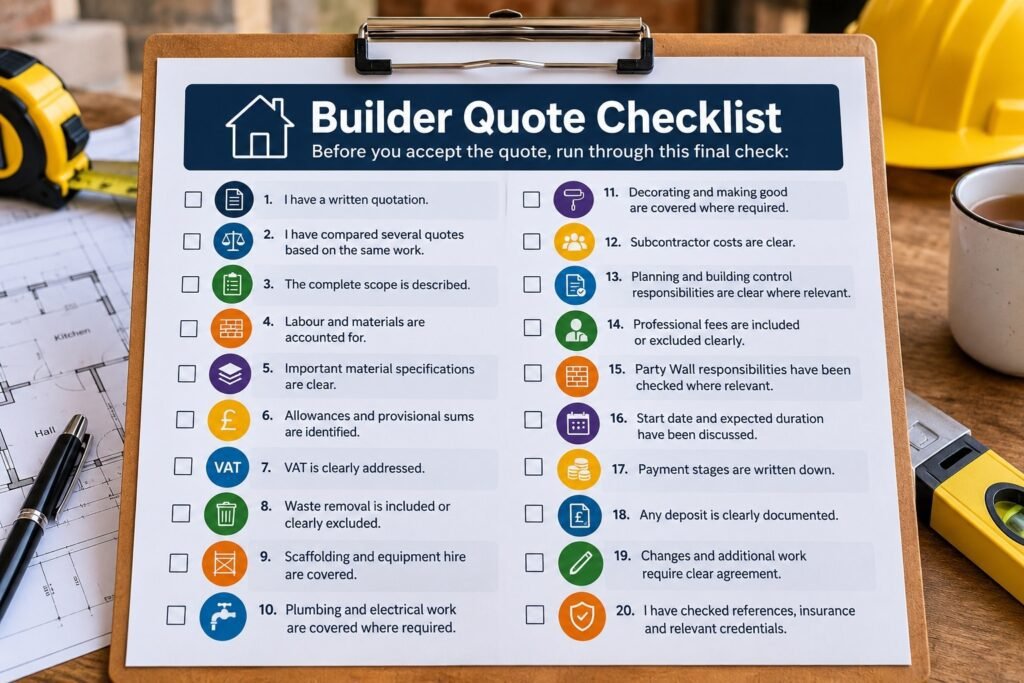
Before you accept the quote, run through this final check:
☐ I have a written quotation.
☐ I have compared several quotes based on the same work.
☐ The complete scope is described.
☐ Labour and materials are accounted for.
☐ Important material specifications are clear.
☐ Allowances and provisional sums are identified.
☐ VAT is clearly addressed.
☐ Waste removal is included or clearly excluded.
☐ Scaffolding and equipment hire are covered.
☐ Plumbing and electrical work are covered where required.
☐ Decorating and making good are covered where required.
☐ Subcontractor costs are clear.
☐ Planning and building control responsibilities are clear where relevant.
☐ Professional fees are included or excluded clearly.
☐ Party Wall responsibilities have been checked where relevant.
☐ Start date and expected duration have been discussed.
☐ Payment stages are written down.
☐ Any deposit is clearly documented.
☐ Changes and additional work require clear agreement.
☐ I have checked references, insurance and relevant credentials.
The cheapest quotation can turn out to be poor value if important work has simply been left out.
Take your time. Compare the scope rather than only the total. Ask the builder to clarify anything vague before you agree to the work.
A few questions before work begins are much easier to deal with than an argument over what was supposed to be included halfway through the project.