
Why choose continuous drainage?
A dehumidifier with continuous drainage sends water down a hose instead of filling a tank, so it can run for days or weeks without you. It is essential for garages, cellars, holiday homes and anyone tired of emptying a tank twice a day.
- How continuous drainage works
- Our top picks
- Hose and condensate pump setup
- Common mistakes
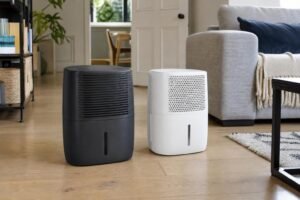
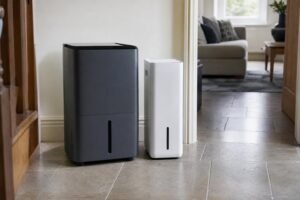
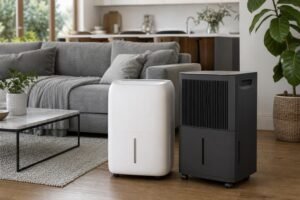
A dehumidifier with continuous drainage is the difference between a machine you babysit and one you can forget about. Most dehumidifiers collect water in a tank of two to five litres, and when it is full they stop. In a damp home, on laundry days or in a cellar, that can mean emptying the tank morning and evening. Miss it, and the dehumidifier sits idle while the damp returns.
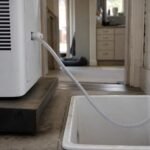
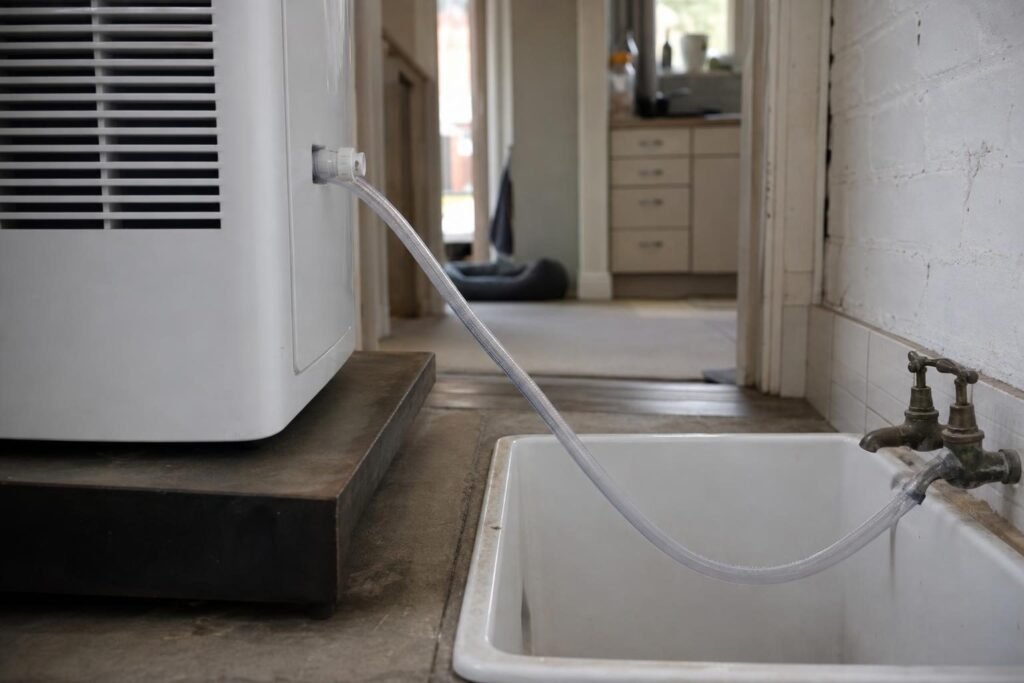
With continuous drainage, a hose connects to an outlet on the dehumidifier and carries water away by gravity to a drain, sink, gully or large container. Some setups add a small condensate pump to lift the water upwards. Below we recommend the best dehumidifier with continuous drainage for different situations and explain exactly how to set one up. For general buying advice, see our guide to the best dehumidifiers.
Key takeaways
- How it works A hose from the dehumidifier’s drainage spigot carries water away by gravity.
- Golden rule The hose must fall downhill all the way, with no kinks or upward loops.
- Best for unattended use Models with continuous drainage plus auto-restart, such as the EcoAir DD3 Classic MK3 or Meaco DD8L Zambezi.
- Check the box Some models include a hose, such as the EcoAir DD1 and DD3; others, such as the Meaco Arete One, do not.
Our top picks at a glance


How continuous drainage works
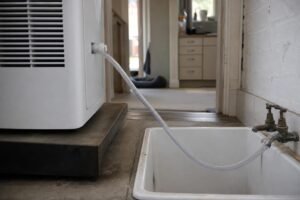
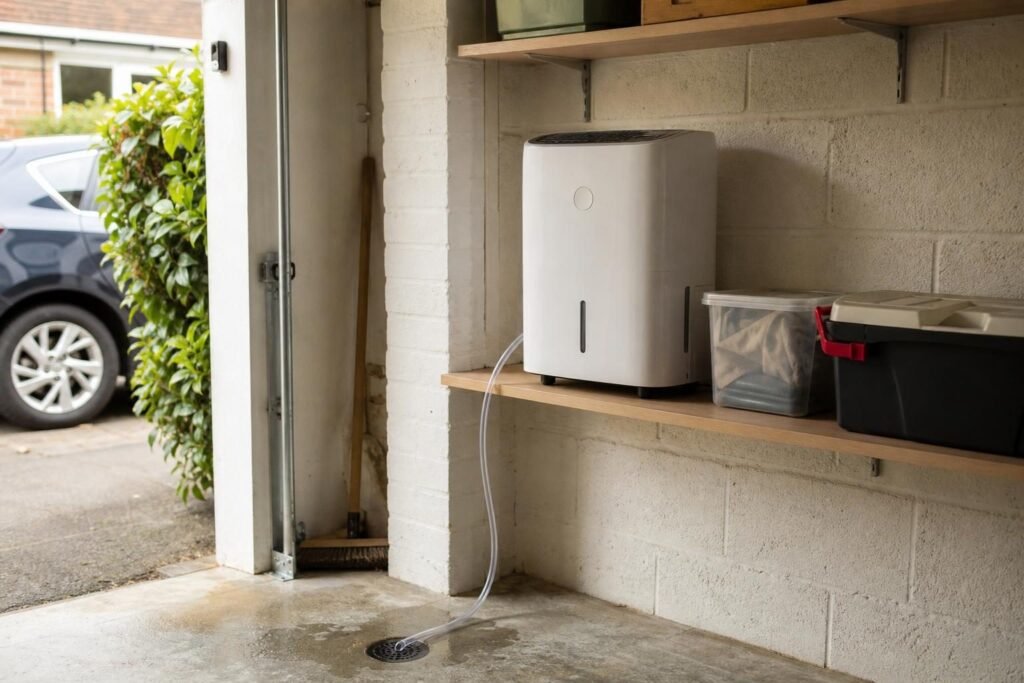
Most dehumidifiers with continuous drainage have a small spigot at the back or behind the tank. You remove a cap, push on a hose (usually around 10–13mm internal diameter), and route it to wherever you want the water to go. Gravity does the rest. The tank stays in place but water bypasses it, so the tank-full cut-off never triggers.
Because it relies on gravity, the outlet must be higher than the end of the hose. That is easy if the dehumidifier sits on a shelf above a floor gully, or next to a sink with the hose running into the plughole. If you need to push water upwards, for example out of a cellar, you need a condensate pump or a dehumidifier with a built-in pump.
The best dehumidifier with continuous drainage
1. EcoAir DD3 Classic MK3 – best for unattended use
The EcoAir DD3 Classic MK3 is a desiccant model rated at 11 litres a day with a continuous drainage hose included, auto-restart after power cuts and a digital hygrometer. That combination makes it ideal for garages, conservatories and holiday homes where you might not visit for weeks.
- Drainage hose included
- Auto-restart after power cuts
- Works in cold spaces
- Digital hygrometer
- Higher power draw than compressor models
- Bulkier than compact units
2. EcoAir DD1 Classic MK6 – best compact
The smaller DD1 Classic MK6 also includes a drainage hose in the box and works from 1°C. It is light enough to move easily and suits single garages, boats and caravans. See our EcoAir DD1 Classic MK6 review.
3. Meaco DD8L Zambezi – best for monitoring
The Meaco DD8L Zambezi has continuous drainage (hose not included), a 3-litre tank, auto-restart and a display that shows temperature and humidity. It is a strong choice for cellars and outbuildings.
4. Meaco Arete One 20L – best for heated homes
The Arete One range supports continuous drainage, though Meaco notes the hose is not included. In a heated home with a utility room sink or floor drain nearby, the 20L running on continuous drainage is a quiet, efficient whole-house setup.
5. Ebac 3850e – best British-made
Ebac's 3850e, made in County Durham, has a continuous drainage option, Smart Control and an intelligent defrost system. It suits heated garages, basements and utility rooms.
6. Pro Breeze 20L – best value
Pro Breeze's 20L models include a continuous drainage option alongside laundry mode and large tanks, at around £180–£190.
How to set up a dehumidifier with continuous drainage
- Pick the destination
Choose a floor drain, outside gully, sink or large container. The hose end must be lower than the dehumidifier’s outlet.
- Raise the dehumidifier if needed
Place it on a sturdy shelf or platform to create a downhill fall to the drain.
- Fit the hose
Remove the drainage cap, push the hose firmly onto the spigot and secure it with a small clip if it feels loose.
- Route it without kinks
Keep the hose running continuously downhill, with no loops or upward sections. Cut it to length to avoid sagging.
- Secure the end
Fix the hose end so it cannot jump out of the sink or drain.
- Test it
Pour a little water into the tank area or wait for the first run, and check water flows freely and nothing leaks.
- Check regularly
Look at the hose every few weeks for blockages, algae or kinks, and flush it with warm water occasionally.
If you cannot get a downhill fall, use a condensate pump designed for dehumidifiers to lift water to a drain.
Common continuous drainage mistakes
- Uphill sections: even a small rise causes water to back up and leak inside the machine.
- Hose too long: sagging hose creates dips where water sits and blocks flow.
- Freezing: in an unheated garage, a hose running outside can freeze. Run it to an internal drain or insulate the outdoor section.
- Forgetting the tank: some models still need the tank fitted for the machine to run.
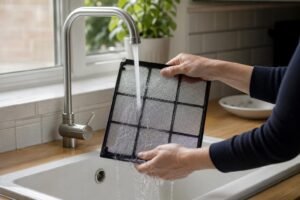
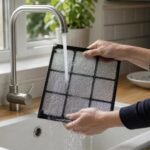
- Ignoring the filter: a clogged filter cuts performance even if drainage works perfectly. See how often to clean a dehumidifier filter.
Running costs
Continuous drainage does not change the electricity a dehumidifier uses. At the current Ofgem price cap of 26.32p per kWh, a compressor model costs roughly 4–7p an hour and a desiccant model 8–19p an hour at full power. Because a dehumidifier with continuous drainage never stops on a full tank, use the humidistat so it does not run longer than needed.
Our verdict on the best dehumidifier with continuous drainage
For unattended use in garages, cellars and holiday homes, the EcoAir DD3 Classic MK3 is the best dehumidifier with continuous drainage thanks to its included hose, auto-restart and cold-room performance. In heated homes, the Meaco Arete One 20L or Ebac 3850e on continuous drainage make a quiet, efficient whole-house setup. Garage owners should also read our guide to the best dehumidifier for garage use.
Frequently asked questions
What is continuous drainage on a dehumidifier?
It is an outlet that lets you connect a hose so water drains away by gravity, instead of filling the tank.
Do all dehumidifiers have continuous drainage?
No. Most mid-range and premium models do, but some compact and mini units do not. Check the specification.
Is a drainage hose included?
It depends on the model. EcoAir includes one with the DD1 and DD3 Classic; Meaco often does not include one with the Arete One.
Can a dehumidifier drain uphill?
Not by gravity. You need a condensate pump or a model with a built-in pump.
Can I run a dehumidifier hose outside?
Yes, but in cold weather the hose can freeze. Insulate it or run it to an internal drain.
Best dehumidifier with continuous drainage: verdict
- Keep the hose falling downhill
- Pair drainage with auto-restart for unattended use
- Use a pump if you need to lift water
The EcoAir DD3 Classic MK3 is our top dehumidifier with continuous drainage for unattended use. Choose the DD1 for compact spaces, the Meaco DD8L Zambezi for monitoring, and the Meaco Arete One 20L or Ebac 3850e for heated homes.