
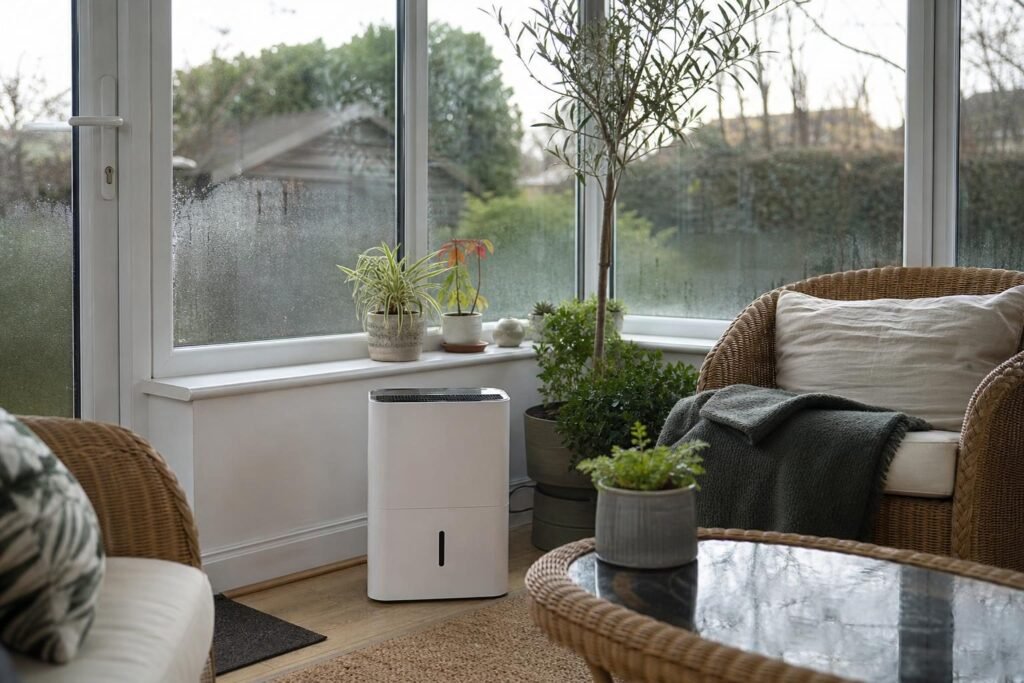
The best dehumidifier for a conservatory
Conservatories are glass boxes that swing from freezing to hot, so they collect condensation in winter and mould in the corners. The right dehumidifier depends on whether you heat the room.
- Why conservatories get so much condensation
- Desiccant vs compressor for glass rooms
- Our top picks
- Placement and running costs
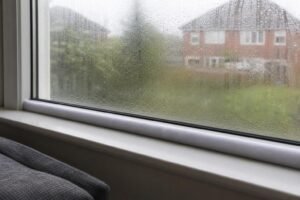
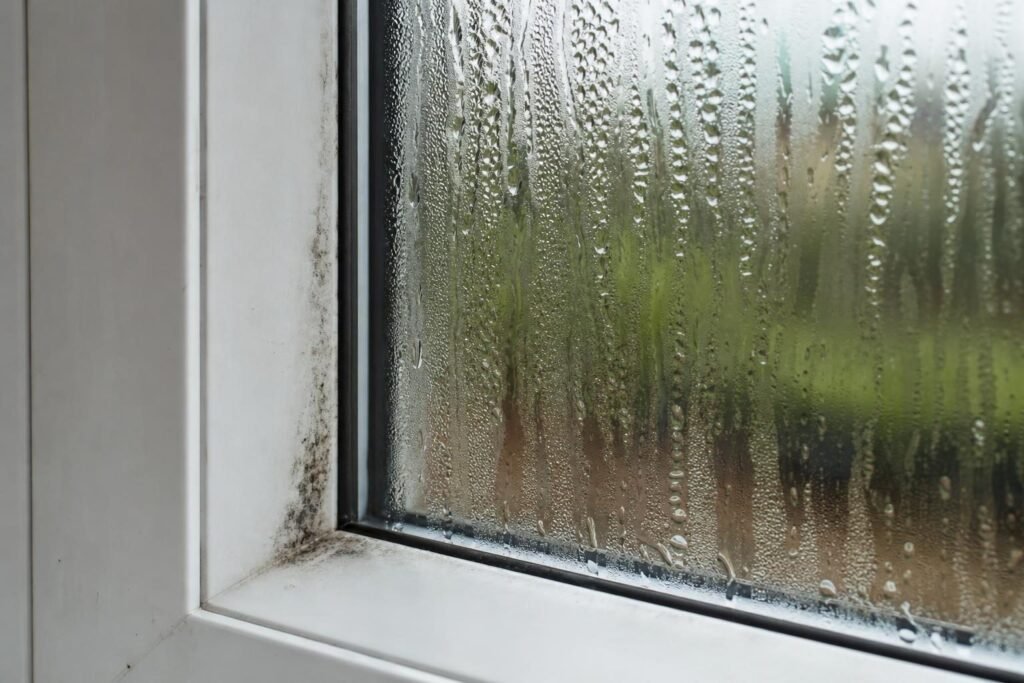
Picking a dehumidifier for conservatory condensation is mostly about temperature. A conservatory loses heat quickly through its glass and roof, so in winter it can sit at single-figure temperatures overnight even if it feels pleasant on a sunny afternoon. Warm, moist air from the house drifts in, hits the cold glass and runs down the frames, and over time that leads to black mould on seals, swollen window boards and a musty smell in soft furnishings.
A good dehumidifier fixes this quickly, but only if it is the right type for how you use the room. In this guide we explain which dehumidifier for conservatory use works in cold glass rooms, which is better if you heat the space, and how to place it so the glass actually stays clear.
Key takeaways
- Unheated conservatory Choose a desiccant model: it keeps working at 1–10°C and blows out slightly warm air.
- Heated all year A low-energy compressor model is cheaper to run once the room stays above about 15°C.
- Top pick EcoAir DD3 Classic MK3 for larger conservatories, EcoAir DD1 Classic MK6 for smaller ones.
- Set and forget Aim for 50–55% humidity and use a timer to cover the cold evening and early morning.
Our top picks at a glance


Why conservatories suffer so badly from condensation
Glass is a poor insulator, so a conservatory's walls and roof are almost always the coldest surfaces in the house. When indoor air at 20°C and 60% humidity meets glass at 8°C, it is well below the dew point and water condenses instantly. Conservatories often have little ventilation in winter, may share an open doorway with a kitchen, and are frequently used to dry washing, all of which pile more moisture into the coldest room you have.
You can reduce the problem by keeping trickle vents open, closing the door between the conservatory and the house overnight, and drying laundry elsewhere. A secondary glazing film on single-glazed sections can also help, as our guide to the best secondary glazing film explains. But for most households, a dehumidifier for conservatory use is the most reliable fix.
Desiccant or compressor for a conservatory?
A compressor dehumidifier condenses water on cold coils. Its performance drops sharply in cool rooms, and below roughly 10°C it removes very little. A desiccant dehumidifier uses a moisture-absorbing wheel and a small heater, so its extraction is far more consistent in cold conditions. It also releases air a few degrees warmer than the room, which helps keep glass above its dew point.
The rule of thumb: if your conservatory is unheated or only heated occasionally, choose desiccant. If it is heated to normal room temperature all winter, choose a compressor model for lower running costs.
The best dehumidifier for conservatory use
1. EcoAir DD3 Classic MK3 – best for medium and large conservatories
The EcoAir DD3 Classic MK3 is one of the largest domestic desiccant dehumidifiers available, extracting up to 11 litres a day, and it is rated for spaces up to 90m². It has a 4.2-litre tank, a digital hygrometer, a timer and a quiet 36dB(A) running level. It has won Which? Best Buy status in 2022 and 2024. It draws 420 to 735W, so use the humidistat rather than running it flat out.
- Up to 11L a day, even in cold rooms
- Large 4.2L tank
- Digital humidity readout
- Quiet for a desiccant at 36dB(A)
- Higher running costs than compressor models
- Bulkier than the DD1
2. EcoAir DD1 Classic MK6 – best for small conservatories
For a small lean-to conservatory, the EcoAir DD1 Classic MK6 delivers 7.5 litres a day from a 6kg unit. It works from 1°C, includes a drainage hose and has a laundry mode if you dry clothes in the room. See our full EcoAir DD1 Classic MK6 review.
3. Meaco DD8L Zambezi – best for monitoring conditions
The Meaco DD8L Zambezi shows room temperature and humidity on its display, so you can see when the glass is likely to stream. It is rated at 7.5 litres a day at 10°C and 60% humidity, has a 3-litre tank and auto-restarts after power cuts.
4. Meaco Arete One 20L – best for heated conservatories
If you heat your conservatory every day, the Meaco Arete One 20L is a quiet, efficient compressor choice. Meaco quotes around 8.5 litres a day at 20°C and 60% humidity for about 216W, and it doubles as an air purifier. It is far cheaper to run than a desiccant in a warm room.
5. Ebac 3850e – best British-made compressor option
Ebac's 3850e is built in County Durham, uses Smart Control rather than a basic humidistat, and has intelligent defrost that keeps it running down to about 3°C. It suits conservatories that are heated but sometimes cool overnight.
What to look for in a dehumidifier for conservatory use
Conservatories are often below 10°C overnight.
Prevents wasted running once the air is dry.
Condensation peaks in the evening and early morning.
A cold conservatory can produce litres overnight.
Matters if the conservatory is a lounge.
Where to place a dehumidifier in a conservatory
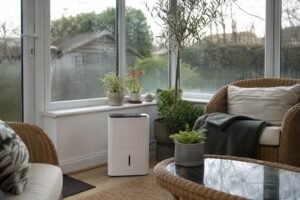
Put the dehumidifier near the worst-affected glass, but at least 20–30cm from walls and furniture so air can flow freely. Close the door to the house so it is not trying to dry the whole home. With a desiccant model, aim the louvre towards the glass to help keep it warm.
Running costs
At the current price cap of 26.32p per kWh, published by Ofgem, a desiccant at 400–600W costs about 10p to 16p an hour at full power, while a compressor model at around 200W costs about 5p. Using a humidistat and timer, most conservatories need a few hours of running each evening and early morning in winter.
Our verdict on the best dehumidifier for conservatory use
For an unheated conservatory, the best dehumidifier for conservatory condensation is the EcoAir DD3 Classic MK3, with the DD1 Classic MK6 a cheaper option for small spaces. If you heat the room daily, switch to a quiet compressor model such as the Meaco Arete One 20L to keep costs down.
Common mistakes with a dehumidifier for conservatory use
Three mistakes come up again and again. The first is buying a compressor model for an unheated conservatory and wondering why the tank stays almost empty. The second is leaving the door to the house open overnight, so the dehumidifier for conservatory condensation is trying to dry the whole home. The third is running it all day in sunshine, when the glass is warm and condensation is not forming. Use a desiccant model in cold rooms, close the internal door at night and run the dehumidifier for conservatory use mainly in the evening and early morning.
Frequently asked questions
Will a dehumidifier stop conservatory condensation?
It will dramatically reduce it. Pair it with closed doors to the house at night and drier habits, such as not drying washing in the conservatory without the dehumidifier running.
What size dehumidifier for a conservatory?
For a small lean-to, around 7 to 8 litres a day from a desiccant model. For large conservatories or orangeries, 10 to 11 litres a day.
Is a desiccant dehumidifier better for a conservatory?
Yes, if the conservatory is unheated or cold overnight, because desiccant models keep working at low temperatures and blow out warmer air.
Should I leave a dehumidifier on overnight in the conservatory?
Yes, on a humidistat setting. Night and early morning are when the glass is coldest and condensation is worst.
What humidity should a conservatory be?
Around 50–55% in winter keeps glass clearer and slows mould on seals and frames.
Best dehumidifier for conservatory condensation: our pick
- Unheated: desiccant
- Heated: compressor
- Target 50–55% and close the door to the house at night
Choose a desiccant for cold conservatories, with the EcoAir DD3 Classic MK3 our top pick and the DD1 Classic MK6 ideal for small rooms. In a heated conservatory, a quiet compressor model like the Meaco Arete One 20L is cheaper to run.