
The best dehumidifier for a garage, in short
UK garages are cold, draughty and damp for half the year, which is exactly the environment where many dehumidifiers struggle. The right choice depends mostly on how cold your garage gets in winter.
- Desiccant vs compressor in a cold garage
- Our top picks for UK garages
- How to stop rust on tools, bikes and cars
- Setting up continuous drainage
Choosing a dehumidifier for garage use is different from choosing one for a bedroom or living room. Most garages in the UK are unheated, so winter temperatures regularly sit between 2°C and 10°C, and that single fact rules out a lot of the cheap compressor dehumidifiers sold for homes.
Damp garages cause real damage. Tools rust, bike chains seize, cardboard boxes go soft, paint tins corrode and stored furniture picks up a musty smell that is hard to shift. A good dehumidifier keeps the relative humidity at around 50 to 60%, which is low enough to slow corrosion and mould without wasting electricity. This guide explains which type of dehumidifier works in a cold garage, recommends specific models, and shows you how to set one up so it can run unattended all winter. For general advice on the causes of damp, see our guide to fixing damp problems.
Key takeaways
- Best type for cold garages Desiccant dehumidifiers keep working near freezing, where compressor models lose most of their performance.
- Top pick EcoAir DD1 Classic MK6: compact desiccant, 7.5L a day, works from 1°C.
- For bigger or double garages EcoAir DD3 Classic MK3 or Meaco DD8L Zambezi, both with continuous drainage.
- Must-have feature Continuous drainage, so you are not emptying a tank in a cold garage every day.
Our top picks at a glance


Desiccant or compressor: which dehumidifier for garage use?
There are two main types of domestic dehumidifier, and the difference matters more in a garage than anywhere else.
Compressor (refrigerant) dehumidifiers work like a small fridge. Air passes over cold coils, moisture condenses and drips into the tank. They are efficient at room temperature, but their extraction drops sharply below about 15°C, and below roughly 5°C the coils ice up and the machine spends much of its time defrosting. Manufacturer extraction figures are usually quoted at 30°C and 80% humidity, conditions a British garage never sees.
Desiccant dehumidifiers use a rotating wheel of moisture-absorbing material, usually zeolite, which is dried by a small heater. Their extraction rate stays broadly consistent across temperatures, they keep working close to freezing, and they blow out air several degrees warmer than the room, which takes the edge off a cold garage. The trade-off is higher power use, typically 300 to 650W rather than 150 to 250W.
For most UK garages the answer is a desiccant dehumidifier for garage use. The exception is an insulated, heated garage or one converted into a gym or workshop that stays above about 12°C, where a modern low-energy compressor model will be cheaper to run.
The best dehumidifier for garage use in the UK
1. EcoAir DD1 Classic MK6 – best overall
The EcoAir DD1 Classic MK6 is the default recommendation for single garages and has held a Which? Best Buy award. It is a compact desiccant dehumidifier rated at 7.5 litres a day at 20°C and 60% humidity, suitable for spaces up to 60m², and it operates from 1°C up to 40°C. At 6kg with a carry handle, it is easy to move between the garage and the house.
Its power draw is 300 to 580W depending on mode, but its smart power-saving mode cycles the heater to cut consumption, and the humidistat stops it running once the air is dry enough. A continuous drainage hose is included in the box, a 2/4/8-hour timer is built in, and the built-in ioniser and silver nano filter are a bonus if the garage doubles as a utility space. Read our full EcoAir DD1 Classic MK6 review for more detail.
- Keeps working from 1°C
- Light and compact at 6kg
- Continuous drainage hose included
- Warm exhaust air takes the chill off
- Higher power draw than a compressor model
- 2L tank fills quickly without a hose
2. EcoAir DD3 Classic MK3 – best for double garages
If you have a double garage, a garage with a damp floor or a lot of stored belongings, the bigger EcoAir DD3 Classic MK3 is worth the extra cost. It extracts up to 11 litres a day, covers up to 90m², has a 4.2-litre tank and a digital hygrometer that shows the real humidity in the space. It draws 420 to 735W and runs at a quiet 36dB(A). It auto-restarts after a power cut, which matters for a garage you might not check for days. See our EcoAir DD3 Classic review.
3. Meaco DD8L Zambezi – best for monitoring
Meaco's DD8L Zambezi is a desiccant dehumidifier with a digital display showing temperature and humidity, a 3-litre tank, continuous drainage and auto-restart. It is rated at 7.5 litres a day at 10°C and 60% humidity, a figure that reflects real winter garage conditions far better than most spec sheets. A useful feature for garages is its ability to step up fan speed when humidity rises well above the set point, so a sudden damp spell does not undo weeks of protection.
- Extraction figure quoted at a realistic 10°C
- Digital temperature and humidity readout
- Auto-restart and continuous drainage
- 3L tank
- Heavier and larger than the DD1 at 7.8kg
- Draws up to around 660W
4. Ebac 3850e – best compressor for an insulated garage
If your garage is insulated and heated, a compressor model makes sense. Ebac's 3850e is made in County Durham, uses Ebac's Smart Control instead of a basic humidistat, and has an intelligent defrost system that lets it keep running down to around 3°C. It is rated at up to 21 litres a day at 32°C and 90% humidity, though real-world extraction in a cool garage will be much lower. At a stated 160W it is cheap to run where it works well.
5. Budget option: a small compressor on a timer
For a garage that is attached to the house and rarely drops below 10°C, a 10 to 12L compressor model, around £100 to £150, can be enough, especially paired with a humidity controlled smart plug that switches it on only when needed. Just be realistic: in a cold January it will remove far less water than the box suggests.
How to choose a dehumidifier for garage use
Garages regularly fall below 5°C in winter.
You do not want to empty a tank in a cold garage every day.
Power cuts happen and garages are checked infrequently.
Headline figures at 30°C/80% are misleading for garages.
Desiccants draw more power, so control matters.
Setting up a dehumidifier for garage use
A few simple steps make a big difference:
- Close the garage up. Seal obvious gaps around the door with brush strips. A dehumidifier cannot dry the outdoors.
- Set the target to 50–55%. That protects metal and stored items without running constantly.
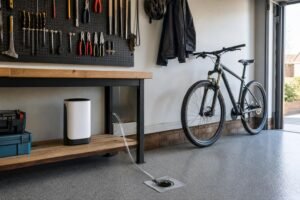
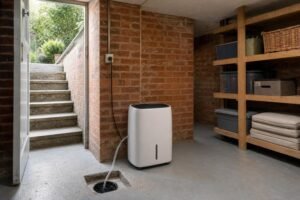
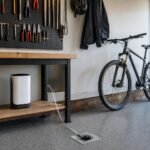
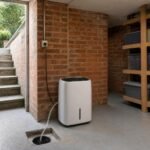
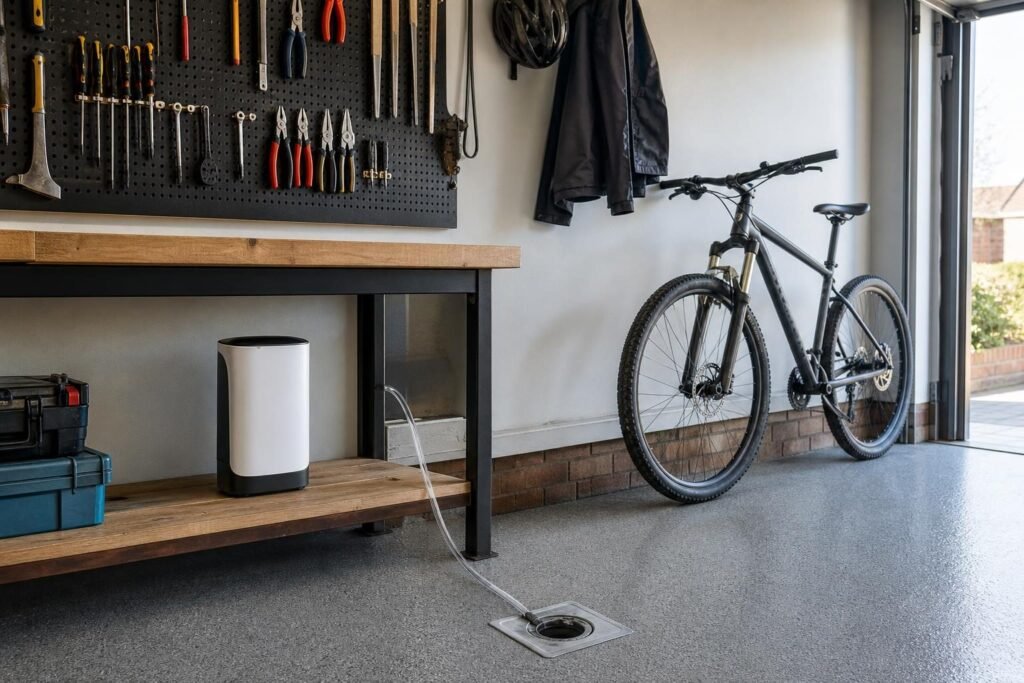
- Use continuous drainage. Run the hose to a floor gully or through the wall. It must fall downhill all the way.
- Raise it off the floor. A low shelf keeps it clear of floor water and dust.
- Check for rising damp or leaks. If the floor is wet, fix the cause first. Our guide to fixing rising damp covers the warning signs.
Running costs of a dehumidifier for garage use
At the current price cap of 26.32p per kWh from Ofgem, a desiccant dehumidifier drawing 300W costs about 8p an hour and around 16p an hour at full power. Because a humidistat stops it once the air is dry, most garages need it running for only part of the day. A realistic winter cost for a single garage is £8 to £15 a month, far less than replacing rusted tools or a mouldy sofa.
Final thoughts on choosing a dehumidifier for garage use
For a typical cold UK garage, a desiccant dehumidifier for garage use is the right call, and the EcoAir DD1 Classic MK6 is the best all-rounder. Go bigger with the DD3 Classic for double garages, choose the Meaco Zambezi if you want to monitor conditions closely, and save compressor models such as the Ebac 3850e for garages that are insulated and heated.
Common mistakes when choosing a dehumidifier for garage use
The biggest mistake is buying a cheap compressor model based on its headline litres-per-day figure and expecting it to cope in January. The second is leaving the garage door unsealed, so the dehumidifier for garage use is effectively trying to dry outside air. The third is relying on a small tank in a space you visit once a week. Avoid all three by choosing a desiccant model, sealing obvious gaps and setting up continuous drainage.
Frequently asked questions
Will a dehumidifier work in a cold garage?
A desiccant dehumidifier will keep working down to around 1°C. Most compressor models lose much of their performance below 10–15°C and struggle below 5°C because their coils ice up.
What humidity should a garage be?
Aim for 50–60% relative humidity. Above 60% for long periods encourages rust and mould; below 50% wastes electricity.
Can I leave a dehumidifier running in the garage all the time?
Yes, if it has a humidistat, auto-restart and continuous drainage. It will switch itself on and off to hold the target humidity.
What size dehumidifier do I need for a single garage?
A desiccant rated at around 7 to 8 litres a day, such as the EcoAir DD1 or Meaco DD8L, suits most single garages. Double garages or very damp spaces benefit from 10–11 litres a day.
Is it safe to run a dehumidifier in a garage with a car?
Yes. Keep it away from fuel cans and solvents, plug it directly into a socket rather than a long extension lead, and make sure the air inlet and outlet are clear.
Our pick for the best dehumidifier for garage use
- Cold garage: choose desiccant
- Set 50–55% humidity and use continuous drainage
- Fix leaks and draughts before buying a bigger machine
The EcoAir DD1 Classic MK6 is our top choice because it keeps working in near-freezing conditions, is light and compact, and ships with a drainage hose. Upgrade to the EcoAir DD3 Classic for bigger spaces, and only choose a compressor model if your garage is insulated and kept above about 12°C.